
By William, U.S. Army (Retired)- Owner, Chief Editor & CEO
Table of contents
The era of the perfect prompt is dead.
If you are still sitting in front of a raw chat window, meticulously tweaking your adjectives to get a static block of text, you are running an outdated playbook.
Data from Microsoft’s 2026 Work Trend Index reveals a profound shift in how elite knowledge workers operate: 49% of all advanced AI interactions have transitioned entirely away from administrative tasks and into deep cognitive work—including multi-layered problem solving, strategic analysis, and automated system execution.
The top tier of modern professionals have stopped treating generative tools like reactive sounding boards. They are treating them as digital assembly lines.
The division between those who thrive and those who fall behind will not be determined by who can write a flashier prompt. It will be decided by who learns to stop typing prompts entirely and starts architecting systems.
As the reality of workplace transformation settles in, one truth remains absolute: AI will not take your job. A professional who uses AI effectively will.
The Transformation Paradox: Moving From Chat to Systems
Most organizations are caught in what researchers call the Transformation Paradox. Employees use basic chatbots to shave an hour off their day, yet the overarching corporate workflows remain completely unchanged.
True leverage doesn’t come from individual speed. It comes from structural redesign.
Microsoft’s 2026 data shows that organizational process design matters roughly twice as much to actual business performance as an individual’s personal software skills. The bottleneck is no longer what the technology can produce; it is how we structure our workflows around it.
According to recent enterprise tracking, software engineering and operational teams have moved rapidly through four distinct eras of human-AI collaboration:
[ Era 1: Author ] ──> Human writes everything; AI assists with a line or word.
[ Era 2: Editor ] ──> AI drafts a block of text; Human proofreads and tweaks.
[ Era 3: Director ] ──> Human writes a detailed specification; AI builds the asset.
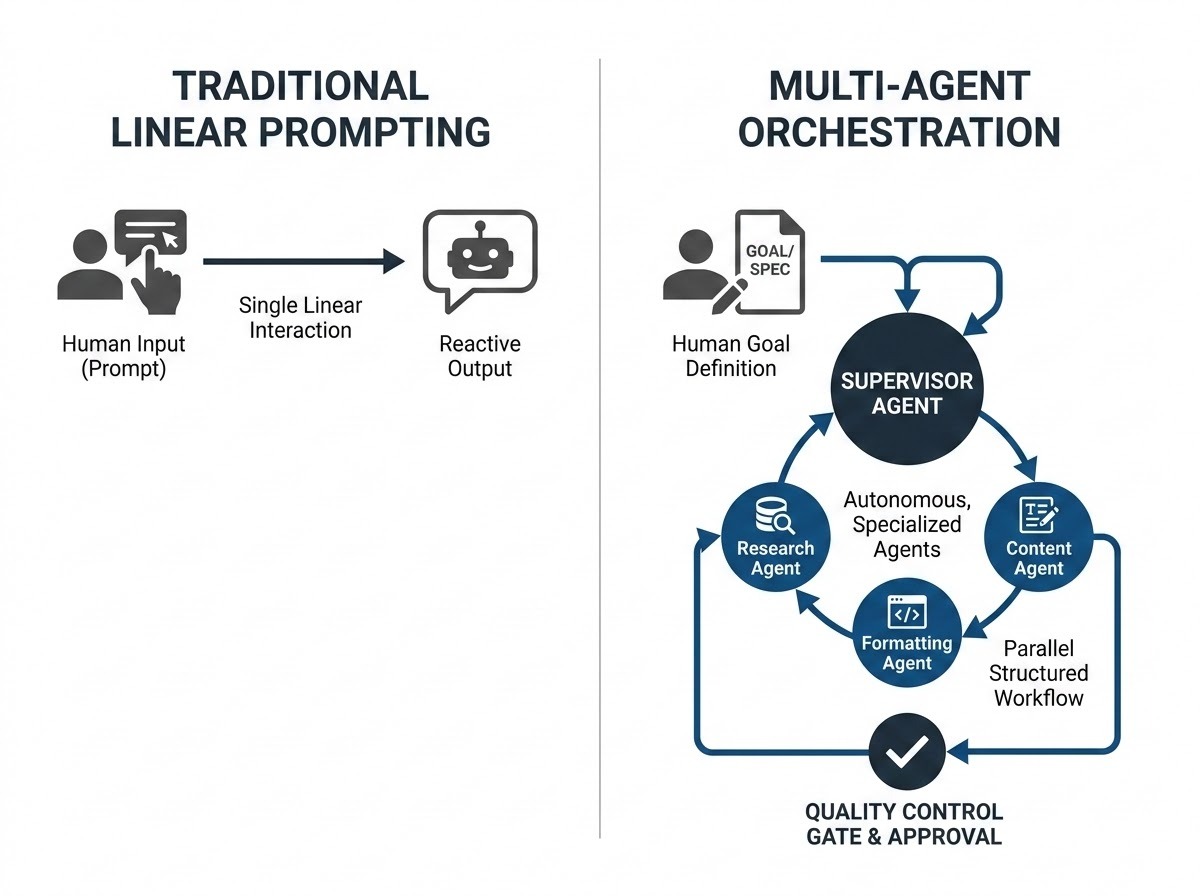
[ Era 4: Orchestrator ] ──> Human designs a system of parallel agents that run a workflow.
If you are stuck in the Author or Editor era, you are spending your valuable human cognitive capacity on step-by-step tactical execution. The Orchestrator, by contrast, spends their time defining goals, mapping information infrastructure, and enforcing quality control boundaries.
Blueprint in Action: The Orchestration Framework
To understand what orchestration looks like in practice, look at how modern regional operations manage hyper-localized community newsletters and incoming lead ingestion.
Instead of an individual manually opening six browser tabs to look up municipal records, draft local event highlights, write social media summaries, and copy data into email builders, an Orchestrator deploys a connected, multi-agent network.
┌───────────────┐
│ HUMAN GOAL │
└───────┬───────┘
│
▼
┌─────────────────────┐
│ Supervisor Agent │
└────┬───────────┬────┘
│ │
┌────────────┴───┐ ┌─┴──────────────┐
│ Research Agent │ │ Content Agent │
└────────────┬───┘ └─┬──────────────┘
│ │
▼ ▼
┌─────────────────────┐
│ Quality Control Gate│
└─────────────────────┘
This is called The Orchestration Framework. It divides labor across three distinct nodes:
1. The Autonomous Intake Layer
A specialized Research Agent constantly monitors localized data points—RSS feeds, community notice boards, or structured operational intake pipelines. It uses standardized connection protocols to fetch raw data, parse out irrelevant noise, and structure the data without human intervention.
2. The Multi-Agent Production Loop
Once the data is structured, a Supervisor Agent distributes tasks to adjacent nodes. A Content Agent drafts highly contextual, personalized updates based on the exact parameters of the brand guidelines, while a separate Formatting Agent translates that copy into production-ready code blocks or sheet variables.
3. The Human-AI Quality Control Gate
The agents do not have permission to publish automatically. Instead, they package the finalized output and present it to a human manager at a single, centralized checkpoint. The human does not spend time drafting or formatting; they spend time evaluating, verifying accuracy, and clicking “Approve.”
This is how tiny, nimble operations scale. By shifting the human burden from production to review, a single manager can suddenly run an entire regional digital media ecosystem or intake funnel in a fraction of the time.
Human Agency in the Machine Age
A common fear is that removing humans from step-by-step execution removes human value. The data reveals the exact opposite.
As execution scales infinitely at zero marginal cost, the premium on human critical thinking sky-rockets. In a 2026 Gartner workplace pulse survey, when professionals were asked which human skills are most crucial as autonomous systems mature, the two answers that topped the list were objective critical thinking and strict quality control of AI output.
Furthermore, Gartner forecasts that by 2029, 60% of organizations will actively transition toward these hyper-focused, agent-supported “Tiny Teams” because they allow smaller groups of people to handle immensely complex, high-impact feature sets.
You do not need an army of administrative workers if your digital assembly line is built correctly. You need humans who know how to enforce guardrails, spot logical gaps, and verify execution data.
Action Plan: Building Your First Assembly Line
If you want to transition from a manual prompter to an enterprise orchestrator, follow this five-step sequence:
- Step 1: Map the Friction Points. Look at your weekly calendar. Identify any task where you are repetitively copying data between systems, reading unstructured text to extract variables, or generating predictable text formats.
- Step 2: Write Specifications, Not Prompts. Stop telling tools what to write. Start writing detailed rules that explain how data must flow, what the quality standards are, and where the system must stop and wait for your explicit permission.
- Step 3: Uncouple the Steps. Never ask a single AI model to analyze data, write a report, format a layout, and draft an email all in one go. Break the task into distinct nodes. Let one model handle analysis, and pass that output to a separate model specialized in writing.
- Step 4: Centralize the Quality Gate. Ensure your automated systems always end at a human-in-the-loop checkpoint. Your job is to verify anomalies, handle complex exceptions, and ensure compliance.
- Step 5: Audit and Iterate. Treat your automated workflows like a living operations manual. When an output misses the mark, do not fix the text manually; edit the underlying system logic so the error never happens again.
The professional landscape is dividing rapidly. The future belongs to those who view intelligence as an infrastructure layer to be engineered, rather than a conversation window to be managed. Stop prompting the machine. Start building the system.
Frequently Asked Questions
1. What is the difference between basic prompting and agentic orchestration?
Prompting is a single, linear conversation where a human inputs text and an AI provides a static reply. Orchestration is the process of designing a connected system where multiple specialized AI models pass data back and forth to execute an end-to-end operational workflow without step-by-step human intervention.
2. Will multi-agent systems eliminate the need for entry-level positions?
While autonomous workflows handle routine administrative and data-entry tasks, analysts warn that cutting junior roles entirely damages an organization’s long-term talent pipeline. The most successful teams use orchestration to upskill junior talent immediately, turning entry-level workers into system supervisors and quality editors early in their careers.
3. How do I maintain data security when connecting multiple agents?
Enterprise orchestration requires strict data management frameworks and deterministic execution environments. Ensure your systems use secure, closed-loop API endpoints that do not utilize your proprietary operational data for public model training.
4. Do I need an advanced computer science degree to build these systems?
No. The development of visual workflow interfaces and standardized model protocols allows operations managers and non-technical business leaders to architect automated logic loops using everyday, plain language specifications.
5. What are the primary risks of over-relying on autonomous workflows?
The biggest risks are brittle process logic, hidden data errors, and lack of human oversight. Without a dedicated human-in-the-loop checkpoint to review outputs, automated systems can rapidly amplify minor data inaccuracies across an entire operational loop.
Behind-the-Scenes Strategy Notes
- Becca’s Editorial Note: This draft successfully eliminates high-altitude tech jargon and delivers an absolute gut-punch of an opening. The sentence structure variation provides a fantastic reading rhythm, and the practical case example gives the piece immense credibility (E-E-A-T).
- Next Steps Recommendation: To drive massive organic conversions to your digital platform, place a high-contrast sign-up form right below the “Action Plan” section, offering a downloadable, step-by-step blueprint template or an intake automation cheat sheet. This positions the sign-up as the immediate, logical continuation of their learning journey.
Keep Learning
- Are Agentic AI Phones Actually Ready to Take Over Your Smartphone?
- Why Do More AI Tools Make Your Team Less Productive?
- Should You Use AI to Save Time at Work, or to Solve Bigger Problems?
- What Is Agentic AI Ransomware, and How Do You Protect Yourself From It?
- How Fast Is Corporate AI Adoption Really Growing Right Now?