

A Wall Street Journal feature on internal AI “champions” programs shows the jump from cautious pilot to daily habit — and the prompts driving it are more copyable than you’d think.
By William, U.S. Army (Retired)- Owner, Chief Editor & CEO
Major corporations are significantly increasing AI integration by moving from occasional experimentation to embedded daily workflows. Law firms and banks have reported exponential growth in prompt volume by shifting focus toward repeatable tasks. This transition is largely driven by internal champion networks that provide peer-led guidance on practical applications.
Research indicates that peer-supported adoption achieves higher sustained usage than top-down mandates. Success relies on developing specific workflow prompts that handle recurring professional duties rather than one-off inquiries. Organizations can replicate this growth by identifying high-frequency tasks, refining prompt instructions, and sharing successful templates across their teams.
Table of contents
- A Wall Street Journal feature on internal AI “champions” programs shows the jump from cautious pilot to daily habit — and the prompts driving it are more copyable than you’d think.
- Key Takeaways
- Why Most Companies Are Stuck at “We Tried AI Once”
- What the Data Actually Shows
- The Real Metric Isn’t Prompt Volume — It’s Where a Company Sits on the Curve
- What Workflow Prompts Actually Look Like
- How to Build This Without an Enterprise AI Budget
- Frequently Asked Questions
- The Takeaway
- Keep Learning
Two years ago, 32 people at the law firm Ropes & Gray were sending a few hundred prompts a month to an AI platform called Harvey. Today, nearly 2,200 employees at that same firm generate more than 282,000 prompts a month, and each of them is using it roughly three times more than they were a year ago.
That is not a rounding error. That is a culture shift measured in six figures.
The Wall Street Journal recently profiled how companies like Ropes & Gray, Citigroup, and Mars, Inc. are engineering this kind of jump on purpose, through internal “AI champion” networks — regular employees who become the go-to person for “how do I actually use this thing on my real work.” Howard Glazer, who co-leads Ropes & Gray’s private equity transactions practice and now serves as the firm’s Head of Practice AI, leads a network of more than 60 of these champions across the firm.
So here’s the direct answer, if you’re short on time: corporate AI adoption isn’t growing because companies bought more licenses. It’s growing because employees moved from asking AI cute questions to building it into recurring workflows — the same three or four prompts, run the same way, every single week. That shift from curiosity to habit is where the real productivity gain lives, and it’s the part most companies skip.
Key Takeaways
- Ropes & Gray’s AI usage grew from a few hundred prompts a month to over 282,000 in two years — a scale jump driven by workflow habits, not just more users.
- Citigroup has crossed 80% employee AI tool adoption and logged 42 million AI interactions since launch, with more than 10,000 engineers using AI tools daily.
- Peer-led “AI champion” programs drive roughly double the sustained usage of top-down mandates, according to workplace analytics research.
- The prompts that actually move the needle aren’t one-off questions — they’re repeatable “workflow prompts” tied to a specific recurring task.
- You can build your own version of a workflow prompt library without an enterprise AI budget or a formal champions program.
Why Most Companies Are Stuck at “We Tried AI Once”
If your company’s AI story sounds like “we did a pilot, a few people liked it, and then it fizzled,” you’re not behind. You’re normal.
Most organizations’ AI rollout looks the same: leadership buys licenses, IT sends a training email, a handful of early adopters play with it for a week, and then it quietly becomes one more browser tab nobody opens. The tool wasn’t the problem. The habit never formed.
I’ve watched this pattern up close with teams that had every reason to succeed — smart people, a real budget, genuine pain points AI could solve — and it still stalled. The reason is almost always the same: nobody showed people what to do with it on Tuesday at 2 p.m. when they’re staring down an actual task. A generic training session teaches you what a chatbot is. It doesn’t teach you what to type when your inbox has 40 unread emails and a client needs a redlined contract by 5.
That gap between “I know AI exists” and “I built AI into my Tuesday” is exactly what separates companies stuck at a few hundred prompts a month from companies logging hundreds of thousands.
What the Data Actually Shows
The Ropes & Gray numbers are the headline, but they’re not the only data point worth your attention.
Citigroup, also featured in the Journal’s reporting alongside Ropes & Gray and Mars, has been just as aggressive internally. More than 10,000 Citi engineers now use advanced AI tools day to day, including agentic AI, and automated code reviews at the bank have topped 1.5 million — creating close to 100,000 hours of developer capacity every week. AI has also cut the bank’s application migration timelines from an estimated 12 months down to about four weeks. By the first quarter of 2026, more than 80% of Citigroup employees had adopted AI tools, generating 42 million interactions since launch, and in the bank’s Markets division, AI now processes more than 4,400 documents a month, freeing up over 1,700 hours of oversight capacity.
Two very different companies — a law firm and a global bank — landed on nearly the same story: the growth wasn’t linear, it was exponential, and it happened once AI stopped being a side project and started being embedded in the actual daily process.
Research on how that embedding happens backs up what these companies are experiencing. Workplace analytics firm Worklytics has found that peer-led AI adoption — the champions model, essentially — achieves roughly 2.1 times higher sustained usage than adoption driven by top-down mandate alone. Separate research cited by AI training firm Hartz AI found generic, tool-focused training programs achieve only about 23% sustained adoption, while role-specific training built around actual job functions gets closer to 67%. The gap isn’t the technology. It’s whether someone showed you the prompt for your job, not a generic demo.
The Real Metric Isn’t Prompt Volume — It’s Where a Company Sits on the Curve
Here’s where I want to push back on the way most people read stories like this. The 282,000-prompts-a-month number is eye-catching, but prompt volume by itself tells you almost nothing. A firm could hit that number with everyone asking “summarize this email” a thousand times, and it wouldn’t move a single business outcome.
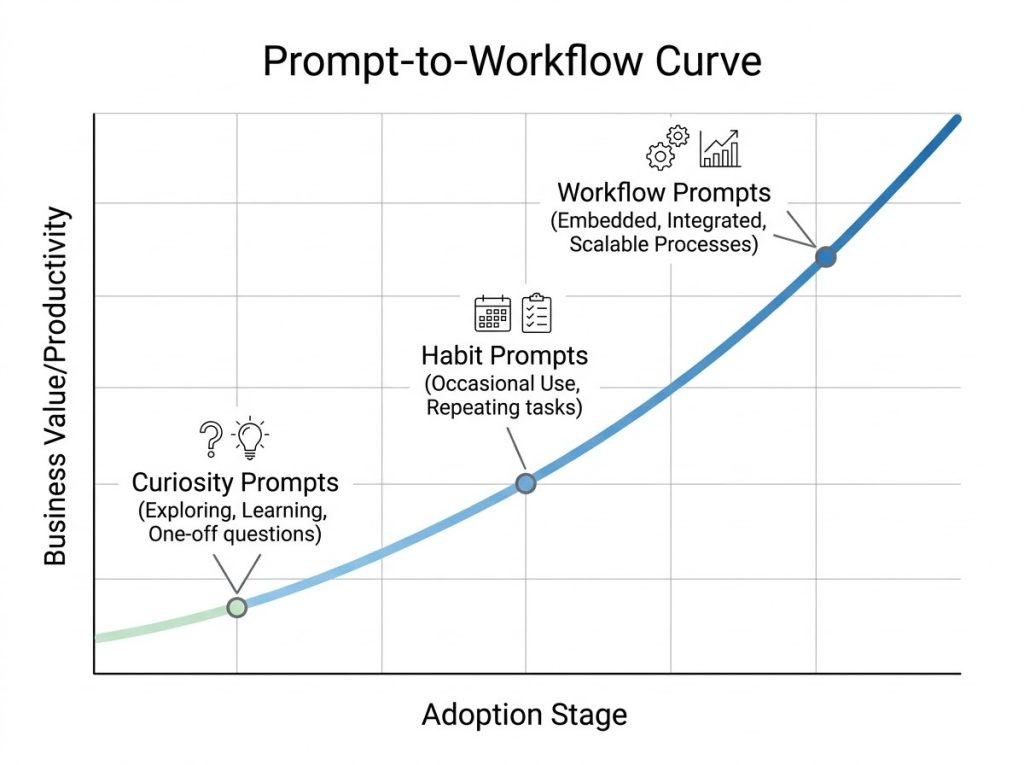
What actually predicts whether AI adoption sticks is what I think of as the Prompt-to-Workflow Curve — three stages every team passes through, whether they realize it or not:
- Curiosity Prompts. One-off, exploratory, disconnected from any repeatable task. (“What’s the difference between an NDA and an MSA?”) Useful for learning. Worthless for productivity metrics.
- Habit Prompts. The same general request, run occasionally, usually copy-pasted with edits each time. This is where most stalled pilots live forever.
- Workflow Prompts. A specific, repeatable prompt tied to a recurring task, refined until it reliably produces usable output on the first or second try — often built into a template, a saved playbook, or a shared workflow tool.
The companies the Journal profiled didn’t get to 282,000 monthly prompts by having more curious employees. They got there because champions helped colleagues move specific tasks all the way to stage three. That’s the part worth copying.
What Workflow Prompts Actually Look Like
To be direct about sourcing: I don’t have access to the literal prompts Ropes & Gray, Citigroup, or Mars employees type into their internal tools — that’s proprietary, and it should be. What follows are representative examples, built from the publicly documented capabilities of the platforms these industries use, showing the kind of specific, repeatable structure that turns a Habit Prompt into a Workflow Prompt.
In legal (the Ropes & Gray pattern, using a platform like Harvey):
“Review this NDA against our standard playbook. Flag any clause that deviates from our fallback positions on confidentiality duration, indemnification caps, and governing law. Summarize each deviation in one sentence and note whether it’s a dealbreaker, a negotiation point, or acceptable as-is.”
This is the shape of prompt behind Harvey’s contract-review and diligence tools, which the platform’s own case studies say can compress multi-day vendor contract reviews into a couple of hours when the review is run against a defined playbook rather than from scratch each time.
In banking and engineering (the Citigroup pattern):
“Review this pull request against our internal coding standards. Flag any security vulnerabilities, unused dependencies, or deviations from our error-handling conventions. Summarize the changes in plain language for a non-technical stakeholder update.”
This is close to the structure behind the automated code-review agents that have helped Citigroup’s engineering org reclaim roughly 100,000 developer hours a week — a repeatable check run the same way on every pull request, not a one-off question.
In consumer goods and marketing (a plausible Mars-style pattern):
“Summarize consumer sentiment from these 200 product reviews into three themes: what’s working, what’s frustrating people, and one emerging complaint we haven’t addressed in past reports. Write it as a one-page brief for a brand manager, not a data scientist.”
In customer service (the Citigroup pattern):
“Given this customer’s account history and their message below, draft a response that resolves their billing question in the fewest possible steps, flags whether this needs human escalation, and matches our brand tone: direct, warm, no corporate jargon.”
Notice what all four have in common: a specific input, a specific format for the output, and a rule for handling the edge case (dealbreaker vs. negotiation point, escalate vs. resolve). That specificity is what makes a prompt reusable instead of a novelty.
How to Build This Without an Enterprise AI Budget
You don’t need 60 trained champions or a six-figure Harvey contract to apply this. Here’s how to start moving your own team from Habit Prompts to Workflow Prompts this month.
-
Pick one recurring task, not ten. Look at what eats the most repeated hours on your team — contract review, meeting recaps, weekly reporting, first-draft emails — and start there. Trying to “roll out AI” broadly is how most pilots die.
-
Write the prompt down and refine it twice. Run it, look at what’s wrong with the output, and adjust the instructions — not just once, but a second time. Most people quit after one bad result and conclude “AI doesn’t work for this.” The magic is usually in round two or three.
-
Save it somewhere everyone can find it. A shared doc, a team wiki page, a pinned Slack message — it doesn’t need to be fancy. The point is that the fifth person who needs this prompt doesn’t have to reinvent it.
-
Name an informal champion, even if it’s just you. The research is consistent on this: peer-taught adoption beats mandated adoption by a wide margin. You don’t need a title. You need one person who’s willing to answer “how did you get it to do that?” three times a week.
-
Track outcomes, not usage. Don’t celebrate “we sent 500 prompts this month.” Celebrate “we cut contract review from two days to four hours” or “our weekly report now takes 20 minutes instead of two hours.” Outcome metrics are what get the budget renewed.
-
Build in a human checkpoint for anything client-facing or high-stakes. Every serious enterprise deployment — legal, banking, or otherwise — keeps a person reviewing before AI output goes external. Speed is the win. Removing judgment is not the goal.
-
Revisit the prompt every quarter. Models improve, your process changes, and a prompt that worked in January can usually be tightened by April. Treat your best prompts like living documents, not one-time settings.
Frequently Asked Questions
What is an AI “champions” program?
It’s an internal structure where a company trains a network of regular employees — not IT staff — to become the go-to peer for practical AI use in their own department. Ropes & Gray’s program, led by Howard Glazer, includes more than 60 champions firmwide who help colleagues apply AI to their actual daily work.
Why did Ropes & Gray’s prompt volume grow so dramatically?
The firm went from 32 users sending a few hundred prompts a month to nearly 2,200 employees generating over 282,000 monthly prompts in two years, driven largely by champions helping colleagues move from occasional curiosity to repeatable, workflow-embedded use of the Harvey platform.
Is a high prompt count actually a good sign?
Not by itself. Volume alone can reflect shallow, one-off use just as easily as deep integration. What matters more is whether prompts are tied to specific, recurring tasks with measurable time or quality gains, not just raw activity.
Do I need an enterprise legal or banking AI tool to see similar results?
No. The underlying pattern — specific prompt, specific format, defined edge-case rules, saved and reused — works with any general-purpose AI assistant. Enterprise platforms like Harvey add legal-specific grounding and citations, but the workflow habit is what drives the productivity gain.
How long does it typically take to see results from a champions-style approach?
Programs modeled on this approach commonly show measurable results, like increased tool usage and early time savings, within about 90 days of launch, according to workplace AI research, though deeper workflow integration — the kind behind Ropes & Gray’s numbers — tends to compound over one to two years.
The Takeaway
The headline number is impressive: 282,000 prompts a month, up from a few hundred, in just two years. But the number that should actually change how you think about Monday morning is smaller and closer to home — it’s the one recurring task on your desk that you’re still doing the slow way.
Somewhere at Ropes & Gray, a contract review that used to eat an afternoon now takes twenty minutes, because one person figured out the right prompt and someone else was willing to teach it to the next person. That’s the whole model. It doesn’t require a champions network of sixty people. It requires one workflow, refined twice, and shared once.
Start there.
Keep Learning
- Are Agentic AI Phones Actually Ready to Take Over Your Smartphone?
- Why Do More AI Tools Make Your Team Less Productive?
- Should You Use AI to Save Time at Work, or to Solve Bigger Problems?
- What Is Agentic AI Ransomware, and How Do You Protect Yourself From It?
- How Fast Is Corporate AI Adoption Really Growing Right Now?