

No — and the reason why is more useful than the viral prompt pack claiming otherwise.
Using persona prompts like “act like a Stanford professor” primarily changes an AI’s tone rather than its accuracy. While these prompts create an authoritative voice, research indicates they can decrease factual reliability. High hallucination rates remain a significant concern across top models regardless of the persona used.
Effective AI research relies on structured decomposition and chain-of-thought prompting rather than character roles. Breaking topics into assumptions and controversies improves reasoning. Users should treat AI output as a first draft and manually verify every citation and claim against primary sources to ensure factual integrity.
By William, U.S. Army (Retired)- Owner, Chief Editor & CEO
You’ve probably seen the post. “BREAKING: ChatGPT can now help you research like a Stanford PhD professor,” followed by five prompts you’re supposed to paste in and watch the magic happen. It racks up thousands of likes because it promises something we all want: instant expertise, no dues paid.
Here’s the direct answer, before we go any further: telling ChatGPT to “act like a Stanford PhD professor” does not make it research like one. Persona prompts like that change the tone of the answer, not the accuracy of it — and there’s peer-reviewed research showing that specific trick can actually make factual answers worse, not better. But three of the five prompts in that pack are built on a technique that genuinely does work, for reasons that have nothing to do with Stanford, PhDs, or professors at all.
That distinction — between prompt theater and prompt structure — is the whole game. Get it, and you’ll get real research value out of ChatGPT. Miss it, and you’ll get confident-sounding paragraphs that fall apart the moment someone checks your sources.
Key Takeaways
- “Act like an expert” persona prompts improve tone and structure but can measurably reduce factual accuracy on knowledge-heavy tasks, according to 2026 research.
- What actually works in the viral prompt pack isn’t the costume — it’s the forced decomposition: breaking a topic into assumptions, gaps, and controversies before answering.
- Hallucination remains a real, current problem: Stanford’s 2026 AI Index found hallucination rates from 22% to 94% across top models, depending on the benchmark.
- Every AI-assisted research session needs a verification pass. Treat AI output as a first draft, not a citation.
- The fix isn’t better costumes for the AI. It’s better structure in your prompts, plus a verification habit you run every single time.
Why Do “Act Like an Expert” Prompts Feel So Convincing?
Because they work exactly as advertised — just not on the thing you think they’re working on. When you tell ChatGPT to act like a Stanford PhD professor, it does adopt the voice of one: measured, hedged, citation-shaped, confident. That voice is persuasive. It reads like expertise. And that is precisely the problem.
I’ve watched this play out the same way more than once: you paste in a “researched” answer, it sounds airtight, and it isn’t until you go looking for the actual paper behind a specific number that the whole thing starts to wobble. The tone did its job. The tone was never the part in question.
This isn’t a knock on ChatGPT specifically, or a reason to stop using it for research. It’s a reason to get precise about what these prompts are actually doing under the hood, because “sounds authoritative” and “is accurate” turned out to be two different variables — and the viral prompt pack only optimizes for one of them.
What Does the Research Actually Say About AI-Assisted Research?
This is where it gets uncomfortable, because the data is not flattering.
A 2024 study in the Journal of Medical Internet Research tested ChatGPT and Bard on systematic literature reviews and concluded the models should not be used as a primary or exclusive research tool — the hallucinated references were too frequent to trust without full manual verification of every citation.
That’s not an old, outdated problem either. Stanford’s own 2026 AI Index found hallucination rates ranging from 22% to 94% across 26 top models, depending on the specific benchmark and task. And a joint investigation by the BBC and the European Broadcasting Union, drawing on 22 media organizations, found that 45% of AI-generated answers contained at least one significant issue, with 31% having sourcing problems — citations that were missing, misleading, or simply wrong.
Now here’s the part that should reframe how you read that “act like a Stanford PhD professor” prompt specifically. A 2026 study on persona prompting (titled “Expert Personas Improve LLM Alignment but Damage Accuracy“) tested expert-role prompts like “act as a cybersecurity expert” or “you are a senior software architect” across multiple models. The finding: personas help when the task needs tone, style, or alignment — and they hurt when the task needs factual knowledge retrieval, because the instruction-following behavior the persona triggers competes with the model’s ability to pull accurate information from what it learned in training. A separate 2026 analysis of persona prompting across 1,140 questions and 38 expert roles found the same tradeoff: role prompting increases the appearance of expertise depth while reducing clarity, and the effect is domain-dependent, not universal.
Meanwhile, the technique that actually does have a strong, well-replicated track record is unglamorous: chain-of-thought prompting. The original 2022 research (Wei et al., since cited thousands of times) showed that asking a model to work through intermediate reasoning steps — instead of jumping straight to an answer — significantly improves performance on complex, multi-step problems. No professor costume required. Just structure.
The Reframe: It’s Not the Costume, It’s the Checklist
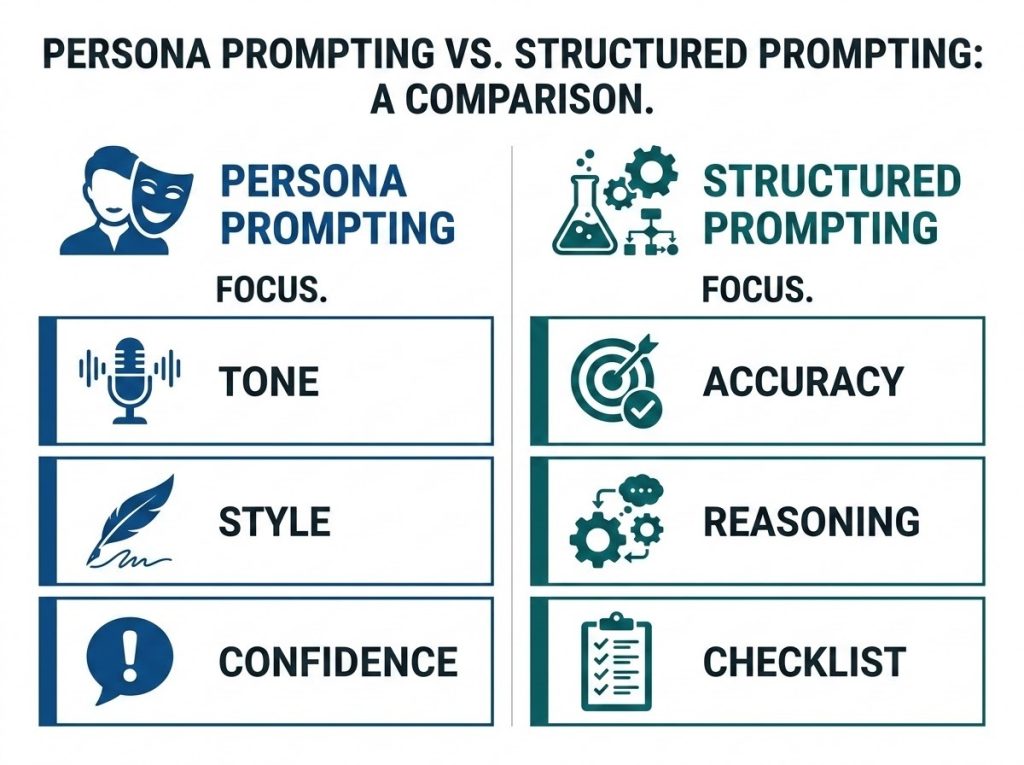
Here’s my actual take, after digging through both the viral post and the research behind it: the five prompts aren’t wrong so much as they’re mislabeled.
Look past the “Stanford PhD professor” framing and what you’re really looking at in prompts like the Deep Research Mode and the Research Blueprint is a forced checklist — identify assumptions, name the controversies, map the knowledge gaps, sequence the concepts. That’s not persona prompting doing the work. That’s structured decomposition, the same underlying mechanic that makes chain-of-thought prompting effective. The professor’s costume is decoration. The checklist is the engine.
Once you see that, the fix is obvious: keep the structure, drop the costume, and add the one ingredient the viral post skips entirely — a verification step. A prompt that forces ChatGPT to lay out assumptions and gaps before answering is genuinely useful. A prompt that also tells it to cosplay as a Stanford professor just adds a layer of unearned confidence on top, at the exact moment you should be getting more skeptical, not less.
How Should You Actually Use ChatGPT for Research?
Think of ChatGPT as a fast, tireless research assistant with one specific flaw: it will hand you a beautifully organized folder that sometimes contains a forged document, and it will never flag which one. Your job doesn’t disappear. It shifts from “find the information” to “verify the information.”
In practice, that means running every research session in two passes. Pass one: use structured prompts (not persona prompts) to generate a map of the topic — key questions, competing views, what’s actually settled versus contested. Pass two: take every specific claim, statistic, or citation that map produced and verify it against a primary source before you use it anywhere that matters.
This is exactly what research librarians have been teaching for the AI era, and their advice converges on the same point from a completely different angle: don’t just confirm a cited source exists, confirm the source actually says what the AI claims it says. One postdoctoral researcher who tried asking ChatGPT to back up claims with scientific studies for his own work put it bluntly — the tool “often generates fake references.” That’s not a reason to abandon AI-assisted research. It’s the whole reason the verification pass exists.
6 Steps for Research That Actually Holds Up
- Swap the persona for a checklist. Instead of “act like a Stanford PhD professor,” try: “Before answering, list the key assumptions, open controversies, and knowledge gaps in [topic].” Same forcing function, none of the false authority.
- Ask for the reasoning, not just the answer. Add “walk through your reasoning step by step before concluding” to any complex question. This is chain-of-thought prompting, and it’s the technique with the actual research behind it.
- Request live links, not just claims. If your version of ChatGPT can browse, explicitly ask for direct links and the date each source was last checked. A claim with no traceable link is a claim you can’t use yet.
- Pull every citation and check it separately. Open a new tab. Search the exact title, author, and year. Confirm the paper exists, confirm the number you were given matches the actual paper, and confirm the finding hasn’t been walked back or superseded since.
- Watch for suspiciously round numbers. Overly clean statistics are a known hallucination pattern. If a figure looks too tidy, find the underlying dataset or table and recompute it yourself.
- Match your scrutiny to the stakes. A first-draft blog outline can survive a light check. A number going into a client report, a grant application, or anything published under your name needs the full verification pass, every time.
Frequently Asked Questions
Does telling ChatGPT to “act like an expert” actually improve its answers?
It improves tone, structure, and confidence of delivery, but 2026 research on persona prompting found it can reduce factual accuracy on knowledge-heavy tasks. Personas help with style and alignment; they can hurt when the task depends on retrieving accurate information.
How often does ChatGPT hallucinate information in research tasks?
It varies widely by task and model. Stanford’s 2026 AI Index put hallucination rates between 22% and 94% depending on the benchmark, and a 2024 study found ChatGPT unreliable enough for systematic literature reviews without full manual citation checks.
What’s the difference between a persona prompt and a chain-of-thought prompt?
A persona prompt assigns a role (“act as an expert”), which mainly shifts tone. A chain-of-thought prompt asks the model to reason step by step before answering, which has strong, well-replicated research support for improving accuracy on complex tasks.
Can I trust ChatGPT’s citations without checking them?
No. Multiple studies, including a BBC/European Broadcasting Union investigation, found roughly a third of AI-generated answers had sourcing problems, from missing attributions to citations that don’t say what the AI claimed. Always verify separately.
What should I actually paste into ChatGPT instead of “act like a Stanford PhD professor”?
Ask it to identify assumptions, controversies, and knowledge gaps in your topic, then reason through them step by step before concluding. You get the same structured depth without the false authority of an unearned persona.
The Bottom Line
The viral post isn’t lying to you, exactly. It’s just pointing at the wrong part of the trick. ChatGPT can absolutely help you research faster and think more clearly about a topic — but not because it’s wearing a Stanford professor’s coat. It’s because a good prompt forces structure onto a conversation that would otherwise wander, the same way a good outline forces structure onto a first draft.
So keep the ambition behind that “BREAKING” post. Just trade the costume for a checklist, and build the verification pass into every single session — not as an afterthought, but as the actual research. The professor title was always optional. The fact-checking never was.
BREAKING: Listen up! Can ChatGPT help you research like a Stanford PhD professor?
Here are the 5 prompts floating around social media:👇
- Deep Research Mode
Act like a Stanford PhD professor. My research topic is [TOPIC]. Before starting, identify the key questions, assumptions, controversies, knowledge gaps, and objectives related to this topic. Then conduct a comprehensive analysis covering historical context, current understanding, competing perspectives, evidence, practical implications, future trends, and unanswered questions. - First Principles Method
Research the topic [TOPIC] using first-principles thinking. Ignore common opinions and surface-level explanations. Break the topic down into its fundamental truths, identify hidden assumptions, reconstruct the subject from the ground up, and explain the underlying mechanisms that govern it. - Research Blueprint
I want to become an expert in [TOPIC]. Create a complete research roadmap that identifies the most important concepts, questions, frameworks, debates, theories, case studies, trends, and practical applications. Organize everything in the optimal sequence for building deep expertise. - Hidden Insights
Research [Topic] and identify the non-obvious insights, hidden patterns, counterintuitive findings, second-order effects, and mental models that experts understand but most people never discover. Focus on ideas that fundamentally change how someone thinks about the subject. - Teach Me Like A PhD
Act as a Stanford PhD professor teaching [Topic] to an exceptionally curious student. Don’t just explain the topic. Explain how experts think about it, what questions they ask, what mistakes beginners make, and what hidden principles govern the field.
Keep Learning
- Are Agentic AI Phones Actually Ready to Take Over Your Smartphone?
- Why Do More AI Tools Make Your Team Less Productive?
- Should You Use AI to Save Time at Work, or to Solve Bigger Problems?
- What Is Agentic AI Ransomware, and How Do You Protect Yourself From It?
- How Fast Is Corporate AI Adoption Really Growing Right Now?
Do you have favorite prompt(s) you like to use that has helped you out personally or professionally? Share them with us…