
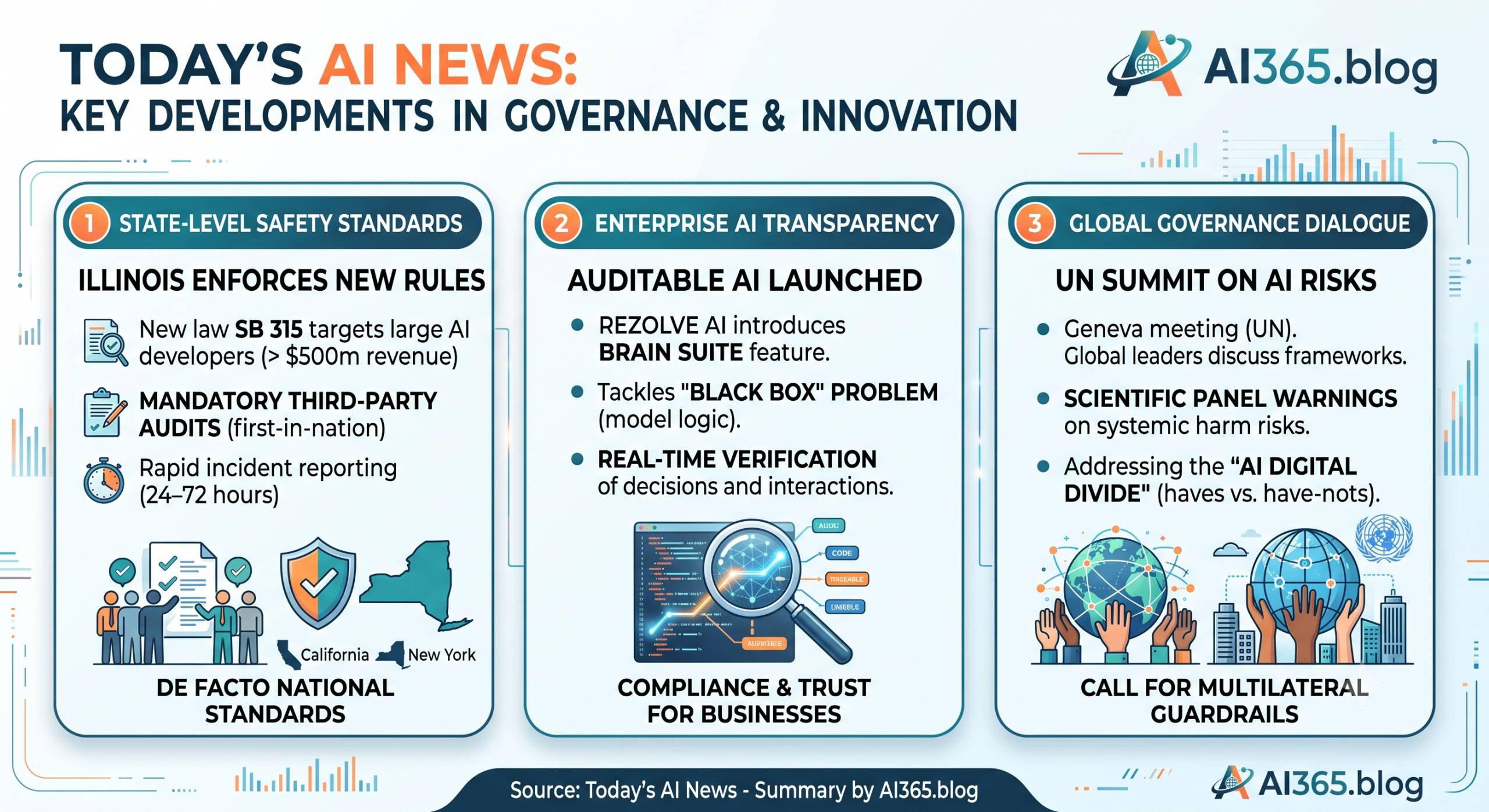
Illinois, California, and New York are establishing a de facto national safety standard for artificial intelligence by implementing mandatory third-party audits and risk reporting for large developers. These state-level regulations aim to address catastrophic risks and ensure developer accountability in the absence of comprehensive federal legislation.
Businesses are adopting new technologies to increase model transparency and resolve the logic gaps in automated decision-making. Meanwhile, the United Nations is advocating for international governance to bridge the global digital divide and establish multilateral guardrails against the systemic risks posed by advanced artificial intelligence systems.
By William, U.S. Army (Retired)- Owner, Chief Editor & CEO
Table of contents
1. States Force a De Facto National Safety Standard
In a major regulatory move, Illinois Governor JB Pritzker signed the Artificial Intelligence Safety Measures Act (SB 315) into law. This legislation specifically targets frontier AI developers with over $500 million in annual revenue. WTTW News
- The Impact: It mirrors landmark frameworks passed in California and New York, but goes a step further by implementing a first-in-the-nation requirement for mandatory annual third-party safety audits. Transparentcy Coalition
- Why it matters: Together, these three states represent roughly 40% of the U.S. AI market. Because the federal government has not passed sweeping safety legislation, this coalition is effectively forcing a de facto national safety standard on major tech firms. Developers must now report potential “catastrophic risks” or major system incidents to the state within 24 to 72 hours. ILGA.GOV
2. Enterprise Demands “Auditable AI”
On the commercial front, Rezolve AI announced the launch of Auditable AI via its proprietary Brain Suite platform. As businesses integrate complex large language models deeper into their workflows, the “black box” problem—where a model reaches a conclusion or recommendation without a clear logic trail—has been a massive barrier to enterprise adoption. This new technology focuses entirely on model transparency, allowing companies to verify, explain, and audit every AI-generated commerce interaction and product recommendation in real time. Resolve AI & National Library of Medicine
3. The UN Concludes the Global Dialogue on AI Governance
In Geneva, the United Nations is wrapping up its two-day Global Dialogue on AI Governance (running July 6–7). The summit kicked off following a stark report published by the UN’s Independent International Scientific Panel on AI, co-chaired by AI pioneer Yoshua Bengio and journalist Maria Ressa. UN & UNESCO
- The Core Debate: The summit highlights a widening “AI digital divide” between the infrastructure-heavy nations leading development (primarily the U.S. and China) and developing nations seeking access to the technology.
- The Warning: Panelists warned that current scientific understanding cannot guarantee advanced systems won’t cause systemic harm without a coordinated, multilateral framework, putting immense pressure on member states to build international guardrails. YouTube
Summary of today’s major AI news:
- De Facto National Safety Standards: Illinois passed the Artificial Intelligence Safety Measures Act (SB 315), joining California and New York in regulating major AI developers. By requiring mandatory annual safety audits, this three-state coalition is effectively forcing a national compliance standard on the tech industry in the absence of federal laws.
- Enterprise Transparency: Rezolve AI launched “Auditable AI” for its commerce platform, tackling the “black box” problem. The technology allows businesses to track, explain, and audit AI decisions and recommendations in real time to ensure accuracy and compliance.
- Global Governance Debate: A UN summit in Geneva highlighted a growing digital divide between dominant AI nations (like the U.S. and China) and developing countries. A prominent scientific panel warned that international guardrails are urgently needed, as current science cannot guarantee advanced systems won’t cause systemic harm.
Q&A
Part 1: State Regulation & Safety Standards
Q: What is the Artificial Intelligence Safety Measures Act (SB 315)?
A: It is a newly signed law in Illinois that targets major, high-revenue AI developers. It requires them to report potential “catastrophic risks” or major system failures within 24 to 72 hours.
Q: Why is the Illinois law being called a “first-in-the-nation” standard?
A: While states like California and New York have passed major AI frameworks, Illinois is the first to implement a mandatory, annual third-party safety audit for large AI developers.
Q: What does “de facto national standard” mean in this context?
A: Because Congress hasn’t passed broad federal AI regulations, tech companies must build their systems to comply with the strictest rules. Together, Illinois, California, and New York represent about 40% of the U.S. AI market, meaning these state laws will effectively dictate how major AI firms operate nationwide.
Part 2: Enterprise Tech & “Auditable AI”
Q: What is the AI “black box” problem?
A: It refers to the challenge where an AI model reaches a conclusion, decision, or product recommendation, but human operators cannot see or understand the underlying logic or steps it took to get there.
Q: How is the tech industry addressing this today?
A: Tech firm Rezolve AI launched “Auditable AI” within its Brain Suite platform. This technology allows businesses to trace, explain, and verify AI-generated interactions and commerce decisions in real time, making the technology transparent enough for strict regulatory and corporate compliance.
Part 3: Global Governance at the UN
Q: What is the “AI digital divide” being discussed at the UN?
A: It is the growing gap between infrastructure-heavy nations leading AI development (such as the U.S. and China) and developing nations that risk being left behind or shut out from the economic and technological benefits of AI.
Q: What did the UN’s scientific panel warn about regarding advanced AI?
A: Co-chaired by AI pioneer Yoshua Bengio, the panel warned that current scientific understanding cannot guarantee that advanced systems won’t cause systemic harm. They stressed that international, multilateral guardrails are urgently needed because individual state laws aren’t enough to manage global risks.
“Should AI safety be regulated state-by-state, or do we need a single national standard immediately?”
Keep Learning AI
-

Are Agentic AI Phones Actually Ready to Take Over Your Smartphone?
Agentic AI phones debuted at WAIC 2026 promising voice-controlled bookings and shopping. Here’s what works, what’s blocked, and what to ask before buying.
-

Why Do More AI Tools Make Your Team Less Productive?
New 2026 data reveals why AI tool overload kills productivity — and the simple Keep, Kill, Combine audit that fixes it.
-

Should You Use AI to Save Time at Work, or to Solve Bigger Problems?
Professionals using AI save an average of one workday per week. However, the most successful individuals do not merely use this time to finish routine tasks faster. Instead, they redeploy those hours toward strategic objectives, judgment-based analysis, and high-value projects that previously lacked the necessary bandwidth for completion. Research indicates that AI is compressing the…