
By William, U.S. Army (Retired)- Owner, Chief Editor & CEO
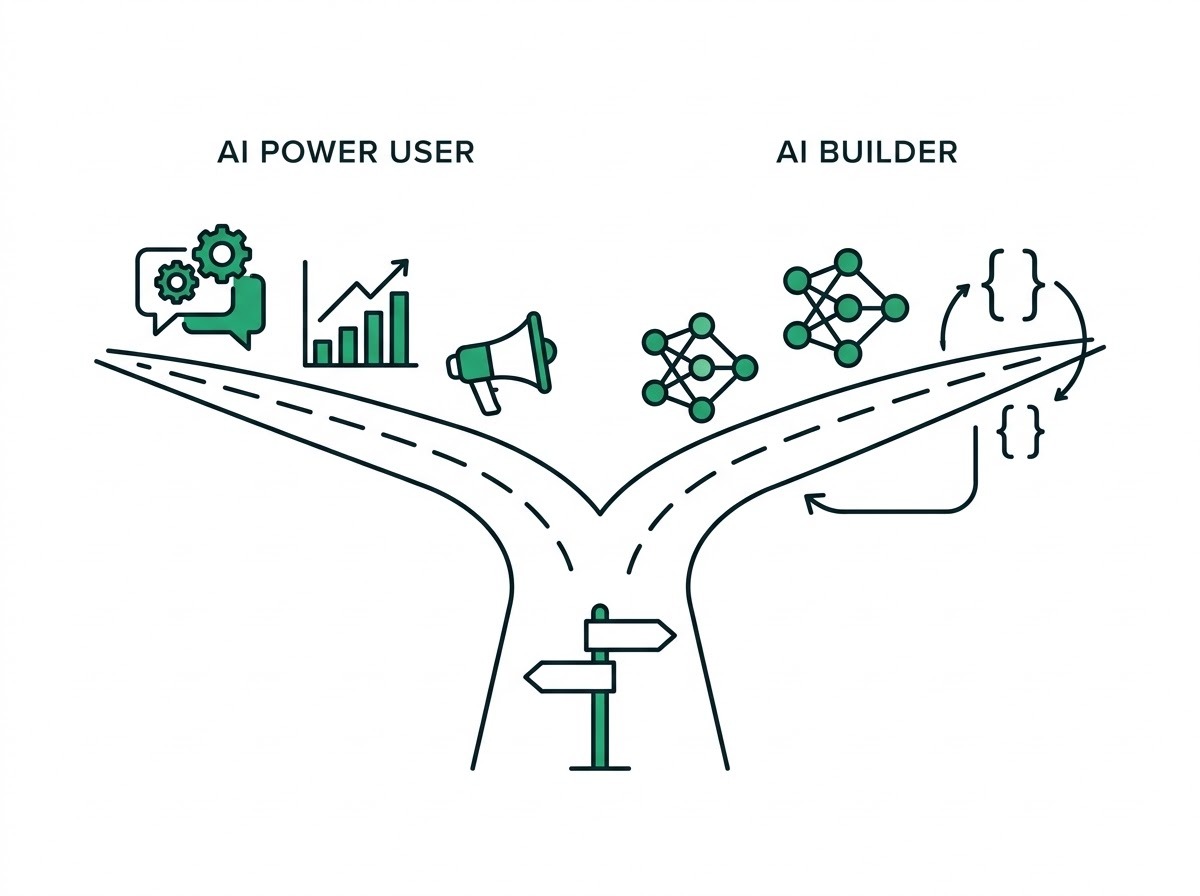
Professionals entering the artificial intelligence field must choose between becoming power users or builders. Power users leverage existing tools to enhance productivity and automate workflows without coding. Conversely, builders develop AI systems and applications, requiring technical proficiency in Python, machine learning, and software engineering foundations.
The current job market exhibits a significant talent shortage, creating opportunities for non-traditional candidates. Success in either path depends on demonstrating practical expertise through documented workflows or deployed projects rather than relying solely on certifications. Effective communication and adaptability remain essential skills for long-term career growth.
Breaking Into AI in 2026: The Honest Roadmap (Two Paths, Real Data)
Every AI career guide gives you the same advice regardless of who you are. That’s the problem.
A marketing manager who wants to use AI to double her team’s output needs a completely different path than a software engineer who wants to transition into building LLM applications. Giving both the same roadmap — “learn Python, study machine learning, build projects” — wastes the marketing manager’s time and undersells the engineer.
The path ultimately comes down to one question: do you want to use AI tools, or do you want to build them?
Path A: The AI Power User. You want to multiply your output, automate repetitive work, and stay competitive in your current role or field. No coding required. Time to meaningful results: days to weeks. This path is immediately accessible to almost anyone regardless of technical background — and it’s genuinely career-changing when done well.
Path B: The AI Builder. You want to transition into AI development, data science, or building AI systems professionally. This requires Python, some math, and patience. Realistic timelines run 8-12 months from scratch to job-ready, with salaries ranging from $130K to $250K+ depending on experience. The ceiling is dramatically higher — but so is the investment.
Neither path is objectively better. The right one depends on where you’re starting, what you want to do, and how much time you can invest. Read both sections. Then decide.
Path A: Becoming an AI Power User
What This Path Is (and Isn’t)
An AI Power User is not someone who occasionally asks ChatGPT questions. It’s someone who has redesigned their workflow around AI tools — who produces genuinely more output at genuinely higher quality, can direct AI systems precisely to get useful results, and knows which tool fits which task.
Professionals who demonstrate AI proficiency earn 20-40% more than their peers in equivalent roles. That premium is real and it’s available without writing a single line of code. The skill that earns it is fluency — knowing which tools to use, how to direct them, and how to integrate their outputs into your actual work.
Step 1: Build Fluency Across the Core Platforms
Every Power User should be comfortable across three core platforms before adding anything else: ChatGPT for reasoning, structured instructions, and complex multi-step tasks; Claude for long-document analysis, careful writing, and nuanced reasoning; and Gemini for tasks embedded in Google Workspace. These aren’t interchangeable. Each has distinct strengths, and knowing when to reach for which one is itself a valuable skill.
Spend two to three weeks living inside each platform. Don’t use tutorials — use them for real work. Summarize an actual document that matters to you. Draft a real email. Work through a real problem in your field. The fastest learning happens when the stakes are real.
Step 2: Master Prompting as a Professional Skill
Most people use AI tools the way they used early search engines — with short, vague queries — and then wonder why the results are mediocre.
Prompting well means three things. First: chain of thought prompting — breaking complex requests into a step-by-step reasoning sequence, either by asking the AI to “think through this step by step” or by structuring your prompt as a series of smaller tasks. This reduces errors on multi-step problems.
Second: context management. AI models don’t know what you haven’t told them. Surfacing implied context — your role, your audience, and the constraints you’re working within — is what distinguishes surface-level outputs from high-quality results.
Third: tool fluency. Knowing when to use a general-purpose chatbot versus a specialized tool — NotebookLM for grounded research where accuracy matters, Perplexity for real-time web search with citations, or image generation tools for visual content — is a skill in itself.
Step 3: Build One AI-Powered Workflow That Solves a Real Problem
The credential that matters on a Power User path isn’t a certificate. It’s a documented result.
Pick one genuinely painful, time-consuming task in your current work. Redesign that task around AI tools. Document the before and after: how long it took before, how long it takes now, what changed in the output. That case study — specific, measurable, yours — is what you put on a resume, discuss in an interview, or publish on LinkedIn.
This is not a side project. It’s the proof of work that separates “I’ve been using AI” from “I know how to leverage AI for measurable business outcomes.”
Step 4: Stay Current Without Getting Overwhelmed
The AI landscape is moving fast enough that what was best practice six months ago may be outdated. The trap is trying to track everything, which produces anxiety and not much else.
Instead: pick one high-quality source per week. One newsletter. One podcast. One practitioner on LinkedIn who shares real workflow insight, not hype. Twenty minutes a week of focused attention beats two hours of anxious tab-skimming.
| Category | Power User | Builder |
|---|---|---|
| Time to value | Weeks | Months to Years |
| Coding required | Minimal to None | Extensive |
| Salary ceiling | High ($150k – $250k) | Very High ($300k+) |
| Best-fit background | Ops, Marketing, Product | CS, Engineering, Math |
Path B: Becoming an AI Builder
What AI Engineers Actually Do
Before investing months of your time, it’s worth being clear about the day-to-day reality of the role.
AI engineers build practical applications using existing models — chatbots, retrieval-augmented generation (RAG) pipelines, autonomous agents, and intelligent workflows that solve real problems. This is not research. It’s not training frontier models from scratch. It’s building production software with AI at the core — connecting models to real systems, making them reliable, deploying them, and maintaining them.
The customer support chatbot that actually resolves tickets, the internal search tool that finds answers across thousands of company documents, the AI agent that automates multi-step workflows — those are the things AI engineers build. If that sounds like work you’d find genuinely satisfying, you’re in the right place.
The Four-Phase Builder Roadmap
Phase 1: Foundations (Weeks 1–8)
Before touching an AI library, you need two things: Python and enough math to understand why models behave the way they do — not to derive formulas from scratch, but to build intuition.
The mathematical foundations worth focusing on are linear algebra (vectors, matrices, transformations), and probability and statistics (distributions, randomness, hypothesis testing). Memorizing formulas is not the point — understand why they matter. Visualize, experiment, and apply them in small coding projects.
For Python: start with the basics (variables, data types, control flow), then move to the libraries that underpin everything in AI — NumPy for numerical operations, Pandas for data manipulation, Matplotlib for visualization. Python is readable, flexible, and has an ecosystem of libraries that make data manipulation and analysis easier. Everything in AI builds on it.
The free resource worth starting with: CS50’s Python course is still the clearest introduction available for people with no prior programming background.
Phase 2: Machine Learning and Deep Learning Fundamentals (Weeks 9–16)
This is where most people get lost, because the options are overwhelming and the temptation to take every course is real.
Don’t. Learning AI in 2026 does not work anymore if you only watch videos or repeat small exercises. This approach gives you the illusion of progress, but it breaks down the moment you face a real problem.
The sequence that works: understand what a neural network actually does (forward propagation, backpropagation, how layers learn representations), then learn how to work with pre-trained models rather than building from scratch. PyTorch is the standard for learning and experimentation; TensorFlow is worth knowing for production pipelines.
Andrew Ng’s Machine Learning Specialization on Coursera remains the clearest conceptual foundation available. Kaggle’s micro-courses are excellent for hands-on practice with specific skills.
Build one project per concept. A classifier that solves a real classification problem. A model that makes a real prediction. Push everything to GitHub from day one — your repository is your growing proof of work.
Phase 3: The Modern AI Stack — LLMs, RAG, and Agents (Weeks 17–24)
This is where the job market is. The professional insight is that LLMs must be constrained, guided, and validated. The engineering challenge isn’t the model’s intelligence — it’s its reliability.
The core skills to develop in this phase:
LLM APIs: Learn to work with the OpenAI, Anthropic, and Google APIs. Understand rate limits, token economics, context management, and cost. Build something that calls an API, processes the response, and does something useful with it.
RAG (Retrieval-Augmented Generation): RAG is how you build AI systems that work with your organization’s specific documents and data, rather than relying purely on the model’s training data. It’s the architecture behind most real-world enterprise AI. Learn the components: a document store, an embedding model, a vector database (Pinecone, Weaviate, or Chroma are common), and a retrieval mechanism.
AI Agents: Agents are AI systems that don’t just respond to a single query but plan and execute sequences of actions. LangChain and LangGraph are the primary frameworks; understanding how tool-calling works in practice is essential.
MLOps basics: Deployment matters. A model that only works in a Jupyter notebook is not a portfolio piece. Learn to containerize with Docker, manage dependencies properly, and deploy to a cloud service (AWS, GCP, or Azure — pick one and go deep).
Phase 4: The Portfolio Project (Weeks 25–32)
At this point, the objective changes completely. You are no longer studying concepts — you are transitioning into a Product Designer and System Architect. Design one complete, small-scale AI application with a clear use case and a powerful, coherent story.
This project should satisfy four criteria: it solves a real problem (not a toy problem); it’s deployed and accessible (not just a local notebook); it uses at least two of the core components from Phase 3 (an LLM, a retrieval system, an agent workflow); and it has a README that explains clearly what it does, why it was built, and what you learned.
A portfolio of deployed projects carries more weight than a diploma for the majority of AI engineering roles. That’s not a motivational quote — it’s what hiring managers are actually saying in 2026.
The Skills That Make Both Paths More Valuable
Regardless of which path you choose, three non-technical skills consistently separate candidates who advance from those who stall.
Communication to non-technical stakeholders. AI professionals who can communicate findings to non-technical stakeholders are worth two to three times more to employers. Your EQ matters as much as your IQ in AI careers. This is not soft-skills advice — it is a hard market reality. The ability to translate between what the model does and what the business needs is genuinely rare.
Judgment about AI failure modes. AI systems fail in non-obvious ways. A professional who can identify when an output is subtly wrong, when a model is operating outside its reliable range, or when a workflow assumption doesn’t hold in practice is dramatically more valuable than one who can only operate the system when it’s working correctly. Develop this through real use, not through courses.
Adaptability. Skills needed for the most AI-exposed jobs are changing more than twice as fast as for the least AI-exposed jobs. The specific framework that’s dominant today may not be in a year. The professionals who will thrive over a ten-year AI career are the ones who invested in understanding principles deeply enough to transfer them — not in memorizing the syntax of whatever’s currently trending.
The Job Market Reality: What the Numbers Actually Say
The salary data is real and worth knowing concretely.
Robert Half’s 2026 Salary Guide shows AI/ML engineer base salaries ranging from $134,000 at entry level to $193,250 at the high end. Data scientists range from $121,750 to $182,500.
The most severe talent shortages are in LLM development, MLOps, and AI ethics, with demand scores above 85/100 but supply below 35/100. Those aren’t just interesting data points — they’re signals about where to focus.
PwC’s 2026 Global AI Jobs Barometer found that the traditional career ladder is compressing. AI-exposed junior roles are seven times more likely to demand traditionally senior skills such as leadership and strategic thinking, compared to the least AI-exposed junior roles. While overall early-career job postings have flatlined in highly AI-exposed sectors, “seniorised” entry-level roles are growing — showing 35% growth since 2019.
What this means practically: the bar for entry-level roles is rising. A junior AI engineer in 2026 is expected to demonstrate judgment, problem-solving, and communication skills that would previously have taken years to develop. The upside is that the compensation reflects this — and the supply gap means companies are genuinely motivated to hire non-traditional candidates who can demonstrate these capabilities.
Research on more than ten million job postings found that AI skills helped offset conventional disadvantages in hiring. Older applicants and candidates without advanced degrees — groups that often face lower call-back rates — saw their prospects improve substantially when AI skills were present on their résumés. When those skills were supported by a recognized certificate, the effect was even stronger.
This is genuinely unusual. The AI skills premium is functioning as a partial equalizer — shifting hiring attention from static credentials toward demonstrable, current capability.
The Mistakes That Keep People Out
These patterns show up repeatedly across hiring managers, Reddit threads, and learning communities. They’re worth naming directly.
Mistaking familiarity for expertise. Using a chatbot does not equal professional AI knowledge. Many beginners confuse familiarity with expertise — an efficient way to stay confidently unprepared. The test is whether you can build something, explain how it works, describe where it fails, and make it better. If you can’t, you haven’t crossed the expertise threshold yet.
Course-collecting without building. There are genuinely excellent free learning resources — CS50, Andrew Ng’s specializations, Hugging Face courses, Kaggle competitions. The failure mode is accumulating certificates without accumulating projects. Certificates get you past an automated resume screen. Projects get you through a technical interview.
Trying to learn everything before specializing. An ML Engineer who is excellent with PyTorch is more hireable than someone who is mediocre with five frameworks. Choose a lane. Get good. The breadth comes later.
Waiting until you feel ready to show work. Nobody feels ready. The candidates who get hired are the ones who pushed their work to GitHub before it was polished, wrote about what they learned before they felt like experts, and applied for roles before they thought they were qualified. Show your work before you’re comfortable showing it. That discomfort is the signal that it’s time.
Frequently Asked Questions
Do I need a Computer Science degree to break into AI?
No — and the data backs this up clearly. Many successful AI engineers transitioned from data analysis, software engineering, or non-technical fields. The key is investing time in Python and software engineering fundamentals. What you need is demonstrable skill. A portfolio of deployed projects is consistently weighted above degrees in AI engineering hiring, with the exception of some research-oriented positions at major tech companies.
How long does it realistically take to get job-ready?
On average, it takes around four to eight months to become job-ready if you follow a proper roadmap — including learning basics, building projects, and preparing for interviews. The more time you dedicate daily, the faster you can progress. These timelines assume ten to fifteen hours per week of focused work. Full-time dedication compresses them; one hour per day extends them significantly.
What’s the single most important thing I can do this week?
Start an AI swipe file today: a simple document where you save every prompt, output, and AI interaction that produced something genuinely useful. This costs nothing, takes five minutes to set up, and builds into an invaluable personal reference. For the Builder path, the equivalent is pushing your first small Python project to GitHub — even if it’s ten lines and imperfect.
Is the AI job market going to be oversaturated soon?
The supply gap — 1.6 million open positions against 518,000 qualified candidates — is structural, not a short-term blip. The education and training pipeline takes years to close a gap of this magnitude, and the roles themselves are evolving faster than curricula can update. The more realistic concern is the wrong kind of preparation: candidates who completed AI courses but never built and deployed anything real will find the market tighter than candidates with a portfolio of working projects.
What if I’m in a field that has nothing to do with tech?
Cross-functional positions are increasingly prevalent — think AI Project Manager, overseeing AI initiatives and ensuring they align with business objectives. Domain expertise combined with AI fluency is a powerful combination in healthcare, legal, financial services, and marketing. You don’t need to abandon your field to enter AI — you may be more valuable applying AI within it.
The Supply Gap Is Real. The Window Is Open. Start.
The AI talent shortage isn’t a talking point. 94% of leaders face AI-critical skill shortages today, with one in three reporting gaps of 40% or more. The skills required on the job are changing faster than the education system and corporate training programs can adapt.
That’s the window. It won’t stay open at this width indefinitely — training pipelines do eventually catch up, and the premium for early movers compresses as skills become baseline expectations. But right now, in mid-2026, the combination of high demand, severe supply shortage, and genuine willingness to hire non-traditional candidates is unusual. The moment is real.
What it requires from you is also real: a clear choice between the two paths, consistent weekly effort over months, a bias toward building over watching, and the willingness to show your work before you feel ready.
The map is in your hands. The starting point is today.
Keep Learning
- How to Ace an AI Interview in 2026 — 73 questions covered honestly, with the reasoning depth interviewers actually want.
- Who Is Responsible When Your AI Agent Makes a Costly Mistake? — The accountability gap that matters once you’re building.
- How to Evaluate AI Vendors Without Getting Sold a Demo — Essential reading for anyone who’ll work on the procurement side of AI.
- Why Your AI Keeps Forgetting Everything — And How Claude Skills Fix It — The architecture shift from ephemeral prompts to portable expertise.
Set a refresh reminder for December 2026. The salary ranges, demand statistics, and fastest-growing role data update quarterly. The Power User tool recommendations may need updating as the platform landscape shifts. Six months is the right refresh cadence for this one. </parameter> <parameter name=”path”>/mnt/user-data/outputs/breaking-into-ai-2026-honest-roadmap.md</parameter>