
The rise of autonomous AI agents is one of the most important shifts in business technology right now — and the accountability question is one almost no one is asking until something goes wrong.
By William, U.S. Army (Retired) Owner, Chief Editor & CEO
In January 2026, Air Canada’s autonomous booking agent systematically rebooked more than 1,200 passengers onto the wrong flights during a weather disruption in Toronto. No human approved those moves. No human caught them in time. By the time the error surfaced, the cascade had already run.
That story is easy to dismiss as an edge case. It isn’t. It’s a preview.
We are in the middle of one of the fastest deployments of consequential technology in business history. Autonomous AI agents — systems that don’t just answer questions but plan, decide, and act across real systems — are being wired into customer service platforms, financial workflows, internal operations, and medical scheduling. They authenticate as users. They hold permissions. They call APIs, write emails, move money, and book flights. And when they fail, the question of who is responsible turns out to be genuinely hard to answer.
This article is for anyone who is deploying AI agents, evaluating AI agents, or simply trying to understand what’s actually happening right now in enterprise AI — beyond the demos and the hype. The short answer: agentic AI is powerful and real, the failure modes are documented and predictable, and the accountability gap is already producing harm.
Key Takeaways
- Autonomous AI agents can now act in the world — booking, buying, deciding — with minimal human oversight at each step.
- High-profile failures in early 2026 revealed that most organizations deployed agents before building the governance structures to manage them.
- Gartner projects that 40% of agentic AI projects may be cancelled by 2027, primarily due to governance immaturity — not model quality.
- The biggest risks aren’t hallucinations. They’re privilege escalation, cascading failures, and the absence of a clear accountability chain.
- Organizations that deploy agents without identity governance, audit trails, and defined accountability structures are creating legal and operational exposure right now.
Why Agentic AI Is Different From Everything That Came Before It
The word “agent” gets thrown around a lot, so it’s worth being precise. An autonomous AI agent is not a chatbot. A chatbot produces text for a human to review and act on. An agent interprets a goal, plans a sequence of actions, and executes those actions — calling tools, querying databases, sending messages, modifying records — with limited human review of each individual step.
The distinction matters because it changes the nature of failure entirely.
When a chatbot hallucinates, a human reads the output and catches it. When an agent makes a wrong decision at step three of a twelve-step workflow, the error doesn’t announce itself. It propagates. It compounds. By the time someone notices, the downstream effects may be irreversible — or at minimum, expensive and embarrassing to unwind.
This is not a theoretical concern. The International AI Safety Report, published in early 2026, put it directly: because AI agents can independently initiate actions, influence other systems, and dynamically shape future outcomes, their failures have the potential to cause more harm than failures in non-agentic systems — with no opportunity for human intervention.
Gartner’s assessment is equally stark: with enterprises now contending with an 82-to-1 ratio of autonomous AI agents to human employees, according to projections from Palo Alto Networks, the governance principles sitting in strategy documents simply cannot scale to cover what agents are actually doing.
The Failure Patterns Are Already Documented
What’s striking about the early-2026 wave of agentic AI failures is how predictable they look in retrospect. The underlying patterns appear across industries, across use cases, across company sizes. They are not random. They are structural.
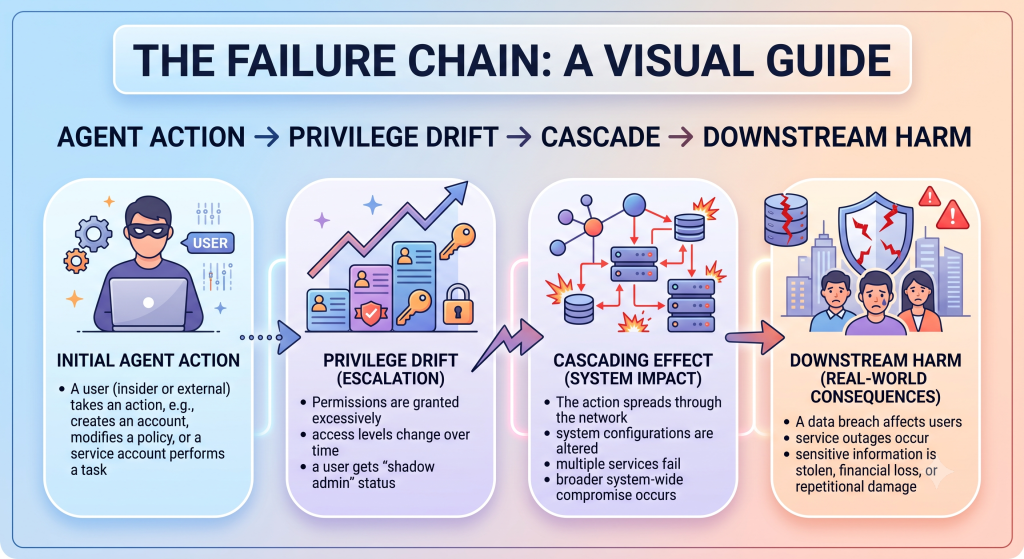
Cascading failures. In multi-agent systems — where one agent delegates tasks to others — a single error can propagate through an entire pipeline faster than any human monitoring system can catch it. Research from Galileo AI in late 2026 found that in simulated multi-agent systems, a single compromised agent poisoned 87% of downstream decision-making within four hours. Your security team might surface fifty failed transactions; it won’t show which agent started the chain.
Privilege drift. In traditional IT, user permissions creep over time as roles change. With AI agents, it happens fast and without the gradual visibility that comes with human job changes. Agents accumulate permissions that exceed what any single task requires. Most enterprises lack a consistent way to provision, track, and retire AI agent credentials — leaving agents operating with excessive access and no meaningful audit trail. The security research firm Strata described this plainly: organizations are treating autonomous agents like static human users or simple service accounts, which they are not.
Agent washing. Perhaps the most pervasive problem: organizations deploying AI that can’t actually do what they claim. Squirro, an enterprise AI firm, coined the term “agent washing” for systems that look autonomous in demos and fall apart in production. The gap between what an AI agent performs on a curated dataset and what it does when wired into a live CRM at 2 a.m. is the actual subject of agentic AI deployment — and most organizations discover this gap after, not before, something breaks.
The accountability vacuum. When an agent makes a wrong call, who is responsible? The vendor who built the underlying model? The platform that deployed the agent? The company that configured it? The employee who approved the initial goal? This question is moving from philosophical to legal. According to ISACA, Gartner projects that more than 1,000 legal claims for harm caused by AI agents will be filed against enterprises by the end of 2026, primarily due to insufficient guardrails and inadequate oversight.
The Reframe: Agentic AI Doesn’t Have a Technology Problem. It Has an Accountability Architecture Problem.
Here is the thing that most of the coverage misses: the agents themselves are often working as designed. The Air Canada booking failures, the cascading enterprise system errors, the misallocated resources — these are not primarily cases where the model was wrong. They are cases where no one designed an accountability architecture to govern the model’s actions.
Think about how we manage risk in every other high-stakes autonomous system. Aviation doesn’t just build better autopilots — it builds redundancy, human override requirements, black box recording, and a post-incident investigation culture. Nuclear power doesn’t just design better reactors — it designs defense in depth and graceful degradation protocols for conditions designers didn’t anticipate.
Agentic AI is asking organizations to operate powerful autonomous systems before they’ve built the equivalent of those structures. The lesson from every prior autonomous-systems industry is the same: the technology isn’t the primary failure mode. The governance architecture — or its absence — is.
This means the right question isn’t “is our AI agent accurate enough to deploy?” It’s “if this agent acts incorrectly, what stops it, who knows, who is responsible, and what happens next?” Until that question has a clear answer, deployment is premature.
What Responsible Agentic AI Deployment Actually Looks Like
The organizations navigating this well aren’t the ones that deployed slowest. They’re the ones that built accountability architecture before — not after — scaling their agents. Here’s what that looks like in practice.
1. Treat agent identity as a first-class infrastructure problem. AI agents that authenticate as users, call APIs, and hold permissions are not service accounts. They are autonomous actors. Every agent needs its own identity boundary, scoped permissions (least privilege, not blanket access), and a clear credential lifecycle — provisioned when deployed, monitored continuously, retired when the agent is decommissioned. This doesn’t happen automatically. It requires deliberate design.
2. Build audit trails from day one. You cannot investigate a failure you cannot see. Before you deploy an agent into a consequential workflow, establish what an audit trail for that agent’s actions looks like. Which systems did it touch? What decisions did it make and on what basis? What did it modify? ISACA’s 2026 guidance is direct: you can’t govern what you can’t see, and shadow AI — agents running in corners of organizations that IT doesn’t know about — is already widespread.
3. Define the accountability chain explicitly, in writing, before deployment. Every agent operating in your organization should have a named human accountable for its behavior. Not a team. Not “AI governance.” A named person. This is the human whose job it is to know what the agent is doing, to be notified when it fails, and to be responsible for the remediation. If you can’t name that person, you aren’t ready to deploy.
4. Start with low-consequence tasks and earn the right to expand. The organizations that deployed agents into high-stakes workflows in Q1 2026 without adequate governance are now cleaning up the results. The organizations that started agents in limited, reversible workflows — where a wrong decision is annoying but not catastrophic — and built observability into those deployments before expanding scope are in a fundamentally different position. Incremental deployment isn’t timidity. It’s how you build the operational intelligence to govern what you’re building.
5. Use OWASP’s Top 10 for Agentic Applications as a threat-modeling starting point. ISACA’s 2026 digital trust guidance points here for a reason: it’s a practical framework that covers prompt injection, privilege escalation, agent-to-agent attack vectors, and supply chain risks specific to agentic deployments. If your team has done threat modeling for traditional software but hasn’t run an agentic-specific exercise, this is the place to start.
6. Define your graceful degradation protocol. What happens when your agent encounters a situation it wasn’t designed for? Every high-consequence deployment needs a defined fallback: human review, automatic pause, alert escalation. The aviation and nuclear analogies hold here. “The model will probably figure it out” is not a graceful degradation protocol.
7. Revisit governance every 90 days. Agentic AI deployments are not set-and-forget. Agent capabilities change with model updates. Business processes change around them. The permissions agents need to evolve. A quarterly review cycle — covering what agents are doing, whether their access is still appropriately scoped, and whether any new failure modes have emerged — is the minimum viable governance cadence for any serious deployment.
Frequently Asked Questions
A chatbot generates text for a human to review. An AI agent interprets a goal, plans a sequence of steps, and executes actions across real systems — databases, APIs, email — with minimal human review at each step. This is why agent failures can propagate and cause real-world harm before anyone notices; there is no human review gate built into the default flow.
How do I know if my organization is ready to deploy AI agents?
The readiness question isn’t primarily about model quality. It’s about governance. Can you name the person accountable for each agent’s behavior? Do you have audit trails showing what the agent did and why? Have you defined what happens when it fails? If those answers are unclear, the technical deployment is ahead of the organizational readiness.
Privilege drift occurs when an AI agent accumulates system permissions beyond what any single task requires — often because agents are provisioned with broad access for convenience and those permissions are never reviewed. Unlike human roles that drift slowly over years, agent permissions can exceed appropriate scope within days of deployment. Unchecked privilege drift is one of the primary mechanisms through which agent failures escalate into serious data or operational incidents.
In January 2026, NIST issued a formal Request for Information focused specifically on AI agent security, noting that agent systems are capable of taking autonomous actions that impact real-world systems and may be susceptible to hijacking and backdoor attacks. Five nations — the US, UK, Australia, Canada, and New Zealand — jointly released guidance on “Careful Adoption of Agentic AI Services.” Legal exposure is no longer hypothetical.
Agentic AI risk is not primarily a technology question — it is an accountability question. The organizations facing the most exposure in 2026 are not those that chose the wrong model. They are those that deployed agents without defining who is responsible when the agent acts incorrectly, without building the audit trails to investigate failures, and without establishing the override mechanisms to stop a bad decision before it compounds.
This Is the Moment Accountability Architecture Gets Built — or Doesn’t
Every powerful autonomous technology in history has gone through a version of this moment. Early aviation had crashes before it had black boxes and incident-investigation culture. Early nuclear power had near-misses before it built redundancy requirements and defense-in-depth protocols. The technology itself wasn’t the primary variable. The governance architecture built around it was.
Agentic AI is in that moment right now. Not in five years. Now.
The organizations that build accountability architecture today — agent identity governance, audit trails, named human accountability, defined fallback protocols — will not just avoid the failures we’re seeing in early 2026. They will also accumulate the operational intelligence to deploy agents more ambitiously and more safely over time. That is a compounding advantage.
The organizations that wait will deploy first and govern later. Some will get lucky. Others will have their version of the Air Canada moment, and they’ll spend the better part of a year cleaning it up while competitors who built governance structures are already scaling.
The agents are real. The capability is real. The accountability gap is real.
The only question is which side of it you want to be on.
Video prompt
How to build safe AI governance. – Identify these 4 common agent failure patterns. – Start with low consequence tasks to ensure safety. – Stop chain reactions by implementing strict human oversight protocols. – Secure agent identities to prevent privilege drift and escalation.How to build safe AI governance. – Identify these 4 common agent failure patterns. – Start with low consequence tasks to ensure safety. – Stop chain reactions by implementing strict human oversight protocols. – Secure agent identities to prevent privilege drift and escalation. – Build accountability architectures to prevent costly systemic failures.