
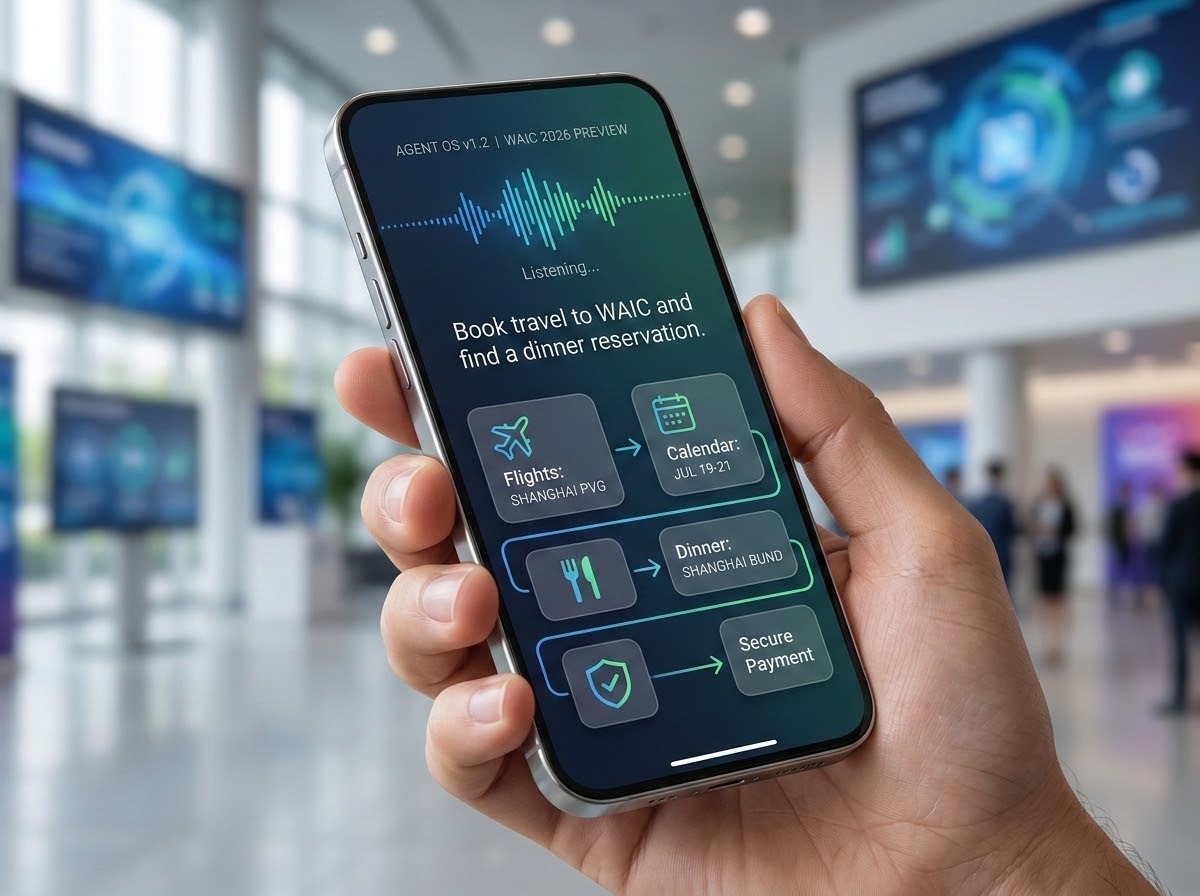
China’s biggest AI show just previewed a phone that shops, books, and manages your apps for you. Here’s what that promise really holds up to.
By William, U.S. Army (Retired)- Owner, Chief Editor & CEO
Table of contents
- China’s biggest AI show just previewed a phone that shops, books, and manages your apps for you. Here’s what that promise really holds up to.
- Key Takeaways
- The Problem: Everyone Wants an AI That Acts, Nobody Wants to Open Their Door to It
- The Evidence: What Actually Happened, and What the Data Says
- The Reframe: This Was Never a Technology Problem. It’s a Front Door Problem.
- The Solution: What a Genuinely Useful Agentic Phone Requires
- Practical Steps: How to Evaluate an Agentic AI Phone Before You Buy One
- Frequently Asked Questions
- The Close
- Keep Learning
- Sources researched in this article
At the World Artificial Intelligence Conference (WAIC) in Shanghai this past weekend, three companies stood on stage and made roughly the same pitch: stop tapping your phone. Just talk to it.
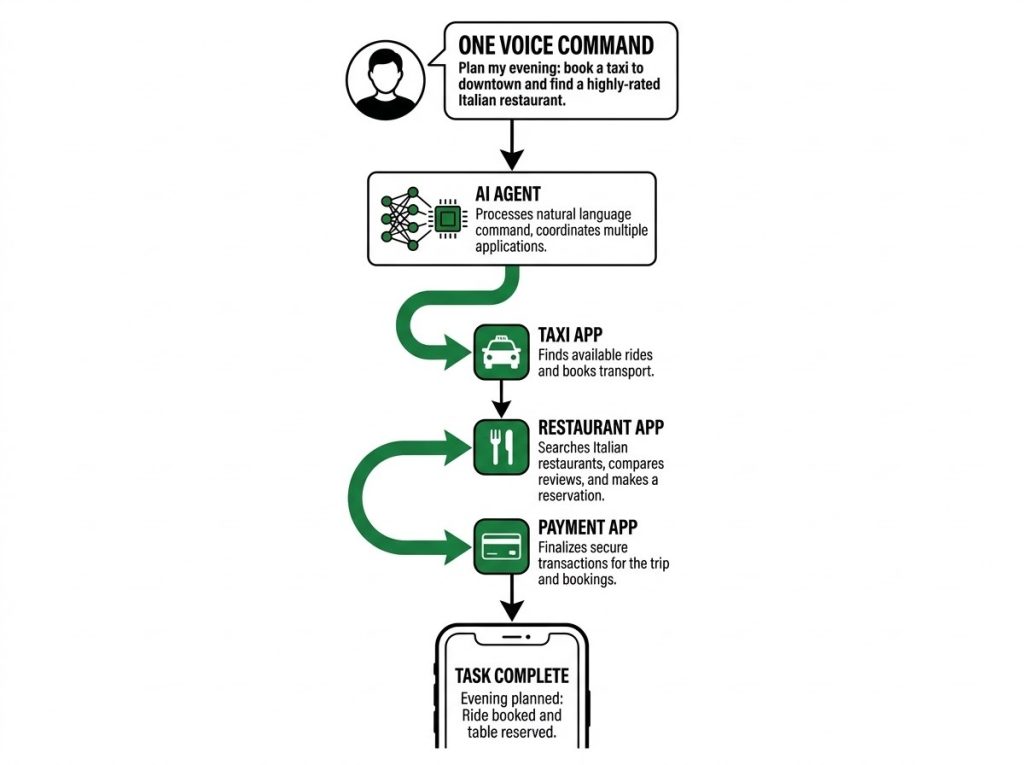
ZTE, showing under its Nubia brand, unveiled the NaviX Ultra and called it the world’s first agentic AI smartphone. Shanghai-based startup StepFun showed off its STEPX Neo. Honor demoed an AI system built into its “Robot Phone.” All three promise the same basic trick — you say what you want, and the phone’s AI agent goes and does it, hopping between apps to book a flight, order dinner, or compare prices, without you touching a single icon.
The direct answer: yes, these are real products, not concept slides — one of them already sold out a limited production run months before WAIC even started. But “agentic” doesn’t mean “solved.” The core technology works in short bursts and controlled demos. What doesn’t yet work, consistently, is getting the apps these agents need to reach into to actually let them in. The most interesting fight at WAIC wasn’t between phone makers. It was between phone makers and the app platforms whose cooperation their entire pitch depends on.
That fight is the real story here, and it’s worth understanding before anyone hands their bank app over to a voice command.
Key Takeaways
- At least three Chinese manufacturers — ZTE (Nubia), StepFun, and Honor — showed working agentic AI phones at WAIC 2026, each built around an AI agent that executes multi-step tasks across apps from a single voice command.
- ZTE’s NaviX Ultra runs on ByteDance’s Doubao agent; a limited-run prototype sold out and resold at nearly double price months before this weekend’s showcase.
- The first-generation Doubao phone was effectively neutered within days of its debut when Alibaba, Tencent, and JD.com restricted its access to their apps — a dispute that’s only partially resolved.
- IDC projects GenAI-enabled phones will account for more than 37% of global shipments in 2026, a market worth roughly $433 billion, with China’s share potentially topping 50%.
- Security researchers have flagged that these agents often rely on system-level Android permissions typically reserved for accessibility tools, raising real questions about consent, data handling, and who’s liable when something goes wrong.
The Problem: Everyone Wants an AI That Acts, Nobody Wants to Open Their Door to It
Here’s the tension nobody’s marketing slide mentions: an AI agent is only as useful as the number of apps it can actually operate. And the companies that own those apps have zero incentive to hand over the keys.
We’ve covered enough “AI phone” launches to recognize the pattern by now. A chatbot that answers questions is easy — it lives inside its own box, reads what you type, and replies. An agent that books your flight has to leave that box. It has to open your banking app, your ride-hailing app, your messaging app, read what’s on screen, tap the right buttons, and know when to stop. That’s an entirely different, much riskier proposition, and it’s exactly where the Doubao phone ran into trouble.
When ZTE’s Nubia M153 prototype (the device that would evolve into the NaviX Ultra) launched in December, it could do something genuinely new: follow a spoken instruction and execute it across multiple apps on its own. It sold out fast. Then, within days, Alibaba, Tencent, and JD.com restricted the assistant’s access to their platforms. WeChat began forcing users out when the Doubao assistant tried to operate inside it. Tencent’s founder, Ma Huateng, said publicly that he opposed sending phone screens to the cloud, calling it “extremely unsafe and irresponsible.” ByteDance responded by pulling back the agent’s ability to handle payments.
That’s not a footnote. That’s the whole ballgame for agentic phones, and it hadn’t fully resolved by the time WAIC opened this year.
The Evidence: What Actually Happened, and What the Data Says
Strip away the demo-stage enthusiasm and a few concrete facts stand out.
The access fight is real and ongoing. Reporting on the Doubao phone’s ecosystem battles found that of 23 apps tested after launch, five — including Taobao, Meituan, and Alipay — blocked logins outright, and three more allowed logins but blocked AI-driven operation entirely. By this year’s WAIC, the picture had only partially improved: the Doubao assistant has since adapted to work with Didi, JD.com, and WeCom under narrower, function-specific permissions, but WeChat still has not opened up AI operation capability, and Alibaba’s Taobao, Xianyu, and Amap maintain strict restrictions.
The security concern isn’t hypothetical. Reporting on the Nubia device found the assistant uses the Android permission INJECT_EVENTS — a system-level capability normally reserved for accessibility tools, which lets software simulate taps and read what’s on screen. ByteDance has said the capability is only used with explicit consent, that screen content isn’t stored in the cloud or used for training, and that sensitive operations like payments aren’t performed autonomously. A security executive who spoke to Nikkei Asia framed the deeper issue plainly: if a user tells an agent to transfer money and it goes to the wrong person, who’s actually responsible — the user, the agent, or the platform that let it in?
The market is moving regardless of whether the kinks are worked out. IDC estimated ahead of MWC 2026 that GenAI-enabled smartphones will make up more than 37% of global shipments this year, a segment worth roughly $433 billion. In China specifically, IDC’s Kiranjeet Kaur has called the AI phone “the sole growth trajectory” for the market this year, with more than half of Chinese shipments potentially AI-native by year’s end. Samsung, for its part, told Axios in January it wants AI features across its entire phone lineup by the end of 2026, aiming to more than double its installed base of AI-equipped devices to over 800 million.
The industry itself admits it isn’t there yet. Kaur, speaking to AFP at WAIC, put it about as bluntly as an analyst can: “Agenting is everyone’s dream, but we haven’t reached there yet,” pointing to the still-patchy real-world performance of these tools.
The Reframe: This Was Never a Technology Problem. It’s a Front Door Problem.
Most coverage of agentic phones treats the story as a capability question: can the AI reliably click the right buttons? That’s the wrong frame, and it’s why so much of the reporting misses what’s actually happening.
Call it the Front Door Problem. Every super-app — WeChat, Alipay, Taobao, Meituan — is not just software. It’s a business built on being the last thing a user touches before they act: the last screen before the purchase, the last tap before the message sends. An agent that operates on the user’s behalf, invisibly, from the phone’s operating system layer, doesn’t just automate a task. It removes the platform from the moment where it actually makes its money and gathers its data. That’s not a security bug to patch. It’s a business model under direct threat, and no amount of better AI changes that math.
This is why the Doubao standoff played out the way it did — banking apps and super-apps didn’t restrict the assistant because the AI was bad at its job. They restricted it because a good agent is the actual problem. And it’s why every phone maker at WAIC this year is quietly building around this same wall: StepFun struck “deep partnerships” with Alipay and Didi specifically so its STEPX Neo would have a front door to walk through; Honor built its agent on models co-developed with Alibaba for the same reason. The agent’s usefulness is now a function of whose walled garden agreed to let it in, not how smart the model underneath it is.
The Solution: What a Genuinely Useful Agentic Phone Requires
Given the Front Door Problem, the phones that will actually deliver on the promise aren’t necessarily the ones with the flashiest demo. They’re the ones solving the access question first.
StepFun’s approach is instructive here. Rather than build a general-purpose agent and hope platforms tolerate it, the company’s chairman, Yin Qi, described securing “deep partnerships” with major services before launch — Alipay for payments, Didi for ride-hailing — so the STEPX Neo can offer what Yin called “one-stop support for travel bookings, everyday purchases, local services, office productivity and video editing” without needing to force its way past a platform’s defenses.
Honor’s Robot Phone takes a related but distinct route: co-developing its underlying AI models with Alibaba directly, rather than trying to operate Alibaba’s apps from the outside as an uninvited guest. That’s a meaningfully different relationship than the one ByteDance found itself in when it tried to run its own agent across platforms it didn’t control.
The pattern across all of this: the winning agentic phones in the next 12 to 18 months will likely be the ones with negotiated access, not the ones with the most impressive independent AI. That’s a genuinely different competitive axis than the one phone makers have competed on for the last decade, and it rewards different skills — partnership and platform diplomacy, not just model performance.
Practical Steps: How to Evaluate an Agentic AI Phone Before You Buy One
If you’re considering one of these devices, or just trying to make sense of the category, here’s where to actually look.
-
Check which specific apps the agent can operate, not just which apps it can “open.” Being able to launch an app and being able to complete a transaction inside it are different capabilities. Ask for a live demo of the exact task you want automated, in the exact apps you use daily.
-
Ask what system-level permissions the agent requires. If a device needs an accessibility-style permission to simulate taps and read your screen, that’s worth understanding before you grant it, the same way you’d think twice before granting any app that level of access.
-
Find out what happens with your screen data. Is it processed on-device, or sent to a server? Is it stored, and for how long? Is it used to train future models? These are reasonable questions to ask any manufacturer before handing over a device that watches your screen by design.
-
Look for a clear liability policy on autonomous actions. If the agent sends money to the wrong person or books the wrong flight, find out in writing who’s responsible before it happens, not after.
-
Treat “sold out” as a demand signal, not a maturity signal. The original Doubao prototype sold out in a limited run and still ran into serious ecosystem restrictions within days. Early sales momentum tells you people are curious. It doesn’t tell you the product is finished.
-
Watch which apps stay locked out over time. A device’s real capability six months after launch — after major platforms have had time to respond — is a far better indicator than its capability on stage at a launch event.
-
Separate the hardware gimmick from the agent’s actual reach. A flip-up robotic camera or a companion persona is a nice feature. It says nothing about whether the underlying agent can actually complete tasks across the apps you personally rely on.
Frequently Asked Questions
What makes a phone “agentic” instead of just having a voice assistant?
A voice assistant answers questions or completes single, narrow actions like setting a timer. An agentic phone’s AI can execute multi-step tasks across several apps from one spoken instruction — booking travel, comparing prices, and completing a purchase — without further prompts from the user at each step.
Is the “world’s first agentic AI smartphone” claim accurate?
Several companies used similar language at WAIC 2026, including ZTE for its NaviX Ultra. The claim is more marketing framing than a settled technical fact, since Nubia, StepFun, and Honor each showed comparable agent-driven devices in the same week.
Why did major Chinese apps block the Doubao AI phone?
Alibaba, Tencent, and JD.com restricted the assistant’s access days after its December launch, citing security and compliance concerns tied to the assistant’s system-level permissions. Analysts also point to a business motive: agents that complete tasks on a user’s behalf threaten the ad- and engagement-based models these platforms depend on.
Are agentic AI phones safe to use for banking or payments?
Banking apps have been among the most restricted for AI agents, and ByteDance itself removed autonomous payment capability from the Doubao assistant after backlash. Treat any agent’s access to financial apps with caution until manufacturers publish clear consent and liability policies.
When will agentic AI phones be available outside China?
None of the phones shown at WAIC 2026 have announced international launches. Global manufacturers like Samsung are adding AI features broadly, but the fully autonomous, cross-app agent model demonstrated by ZTE, StepFun, and Honor remains a China-first phenomenon for now.
The Close
Every big shift in how we use phones has looked like this at first: exciting on stage, messy in practice, and genuinely disruptive to whoever controlled the old way of doing things. Touchscreens threatened keyboard makers. App stores threatened carriers. Agentic AI phones threaten something bigger — the super-apps that decided, for the better part of a decade, that they’d be the last screen you touched before anything happened.
That’s why the sold-out prototype and the WeChat lockout aren’t two separate stories. They’re the same story. The technology to make your phone act on your behalf largely exists already. What doesn’t exist yet is an agreement about who gets to stand at the front door and decide when it’s allowed in.
Until that gets settled, the most impressive agentic phone demo in the world is still, in a very real sense, asking for permission it hasn’t fully been granted.
Keep Learning
- Are Agentic AI Phones Actually Ready to Take Over Your Smartphone?
- Why Do More AI Tools Make Your Team Less Productive?
- Should You Use AI to Save Time at Work, or to Solve Bigger Problems?
- What Is Agentic AI Ransomware, and How Do You Protect Yourself From It?
- How Fast Is Corporate AI Adoption Really Growing Right Now?
Sources researched in this article
AFP / France24 — “Pocket-size AI: Powerful phones star at China show”
https://www.france24.com/en/live-news/20260719-pocket-size-ai-powerful-phones-star-at-china-show
(Also syndicated at aawsat.com, Yahoo Tech, Digital Journal, and Philstar — same AFP wire story.)
Bloomberg — “China Joins Rush to Rethink the Smartphone for the AI Era”
https://www.bloomberg.com/news/articles/2026-07-18/china-joins-rush-to-rethink-the-smartphone-for-the-ai-era
Business Standard — “Chinese tech firms join global race to reinvent smartphones for AI era”
https://www.business-standard.com/technology/tech-news/chinese-tech-firms-join-global-race-to-reinvent-smartphones-for-ai-era-126071800377_1.html
The Next Web — “China is rebuilding the smartphone around AI agents. ZTE’s NaviX sold out in hours.”
https://thenextweb.com/news/china-agentic-ai-smartphones-zte-navix-doubao-waic
People’s Daily Online — WAIC 2026 conference previews (two articles)
https://en.people.cn/n3/2026/0708/c90000-20475542.html
http://en.people.cn/n3/2026/0715/c90000-20477769.html
Startup Fortune — “China Will Debut the World’s First AI Agent Phone at Its Shanghai AI Summit”
https://startupfortune.com/china-will-debut-the-worlds-first-ai-agent-phone-at-its-shanghai-ai-summit/
Business Standard — “Why ByteDance’s AI phone is getting blocked by China’s biggest apps” (Nikkei Asia reporting, syndicated)
https://www.business-standard.com/world-news/bytedance-ai-phone-doubao-nubia-zte-app-blocks-user-control-china-125120800459_1.html
36Kr (Europe) — “Doubao Mobile Phones: Limited-Time Restock Sale Amid Reports of Alleged Regulator Summons…” (Time Weekly reporting, translated)
https://eu.36kr.com/en/p/3599360876625925
Baidu Baike — “Doubao Phone Assistant” wiki entry (app-blocking timeline/testing details)
https://baike.baidu.com/en/item/Doubao%20Phone%20Assistant/1517167
BigGo Finance — “Second-Generation ‘Doubao Phone’ Set for WAIC Debut: Can ZTE’s Nubia and ByteDance Break Through Ecosystem Barriers?”
https://finance.biggo.com/news/ba01fb49-6bb9-4e02-8e2f-73fcda2afb90
Zerlo — “Agentic AI: Smartphone Privacy Risks” (INJECT_EVENTS permission detail, citing Yicai Global/SCMP/Reuters)
https://zerlo.net/en/blog/what-are-the-privacy-concerns-with-agentic-ai-smar