

A new national survey says yes — and the real story isn’t adoption, it’s what comes next.
By William, U.S. Army (Retired)- Owner, Chief Editor & CEO
AI use in higher education has reached a tipping point, with over half of students and faculty using the technology weekly. While adoption is high, many institutions lack effective policies. The focus is shifting from monitoring academic integrity to integrating AI into curriculum and preparing graduates for future employment.
Employers report that graduates often lack the critical judgment needed to evaluate AI outputs. To address this, institutions are encouraged to redesign assessments and provide ongoing faculty training. Transitioning to full integration helps ensure that instructors and students can effectively navigate AI-driven workplace changes.
Table of contents
- A new national survey says yes — and the real story isn’t adoption, it’s what comes next.
- Key Takeaways
- Why Has This Been So Hard for Higher Ed to Get Right?
- What Does the Research Show?
- The Real Shift: From Access Problem to Integration Problem
- What Crossing the Gap Actually Looks Like
- Six Practical Steps for Institutions Right Now
- Frequently Asked Questions
- The Bottom Line
- Keep Learning
- Sources researched in this article
Yes. According to the newly released Time for Class 2026 report from Tyton Partners and D2L, AI use in U.S. higher education has crossed a threshold that used to feel years away: more than half of instructors and students now use AI at least weekly, and administrators are using it even more than either group. This isn’t early-adopter behavior anymore. It’s the baseline.
The report, based on responses from over 3,000 students, instructors, and administrators at more than 750 U.S. colleges and universities, gives this moment a name: the AI tipping point. And the subtitle tells you where the conversation has actually moved: From Monitoring Students to Engaging Them. For three years, higher ed’s dominant AI question was “how do we catch it?” That question is now a distraction. The real one is “how do we teach with it, and teach it well enough that graduates are actually ready for the jobs waiting for them?”
If you work in higher ed — teaching, administering, designing courses, or building the tools instructors rely on — this shift changes what “doing your job well” means starting now, not eventually.
Key Takeaways
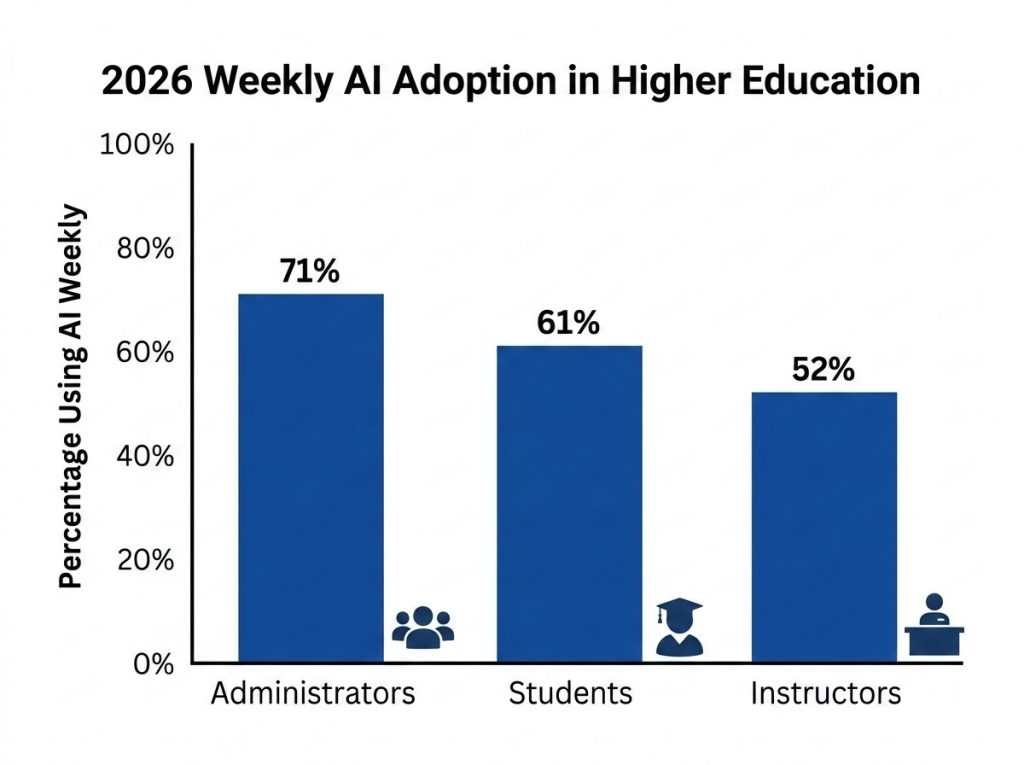
- 61% of students and 52% of instructors now use AI at least weekly, with administrators leading at 71% — the adoption gap between “leadership” and “classroom” has flipped.
- Only 32% of institutions have a central AI policy, and even where one exists, just 22% of faculty say it’s actually effective.
- Daily AI use correlates with real relief: instructors who use AI daily report meaningfully lower workload, but the instructors who most need that relief are often the least supported in getting there.
- A parallel Handshake survey found 85% of graduating seniors now use AI tools, up 31 percentage points in two years — student adoption outran institutional readiness, not the other way around.
- Employers are watching and not entirely satisfied: only 28% believe universities are keeping pace with AI-driven change, per Pearson and AWS research.
Why Has This Been So Hard for Higher Ed to Get Right?
Ask most instructors how the last three years have felt, and “reactive” is the kind word for it. The initial response to generative AI across the sector was defensive: detection software, revised syllabi language, new academic integrity policies written in a hurry and revised again six months later when the tools changed underneath them.
That instinct made sense in 2023. It doesn’t anymore, and the data backs that up. When 61% of students and a majority of instructors are already using AI weekly, treating it primarily as a threat to be monitored puts an institution in the position of policing behavior that is now simply normal. Worse, it means the institution isn’t the one teaching students how to use these tools well — someone or something else is.
That’s the tension underneath the tipping point. Adoption raced ahead of governance. Students taught themselves. Institutions are now trying to build the plane mid-flight: writing policy, redesigning assessments, and training faculty, all while the tools keep changing every few months. The report’s own numbers show the strain — a policy exists at less than a third of institutions, and even those policies satisfy less than a quarter of the faculty living under them. That’s not a compliance problem. That’s a design problem.
What Does the Research Show?
Here’s where the numbers get specific, and where the “so what” starts to matter for anyone planning next semester or next year’s budget.
Key Takeaways
- AI in higher education (2026) has reached mainstream adoption, with over 61% of students and 52% of instructors using the technology weekly.
- Despite high adoption, only 32% of institutions have effective central AI policies, leaving many unprepared for integration.
- Research shows employers are dissatisfied with graduates’ critical evaluation skills regarding AI outputs, highlighting a significant competency gap.
- Institutions now face the challenge of transitioning from merely allowing AI use to seamlessly integrating it into curricula and assessments.
- Ongoing faculty training and redesigned assessments are crucial steps for institutions to meet the demands of AI-driven change.
Estimated reading time: 11 minutes
Adoption has flipped from bottom-up to top-down. The Time for Class 2026 survey found administrators are the heaviest daily users of AI at 43%, ahead of both instructors and students on a daily basis. That’s notable: the popular narrative has always been “students are using AI and the institution is playing catch-up.” Leadership is now moving fast too, which changes the politics of adoption. When the people setting budget and policy are also the heaviest users, “should we invest in this” stops being a live debate.
Policy exists on paper more than in practice. Only 32% of institutions have rolled out a central AI policy, and among faculty at those institutions, just 22% call it effective. That’s a wide gap between “we have a policy” and “the policy actually helps.” A policy written once and left static can’t keep up with tools that change monthly — which is exactly the friction employers and researchers keep flagging across the sector.
Student adoption is outpacing everyone, and it’s not just casual use. A separate Handshake survey of the graduating Class of 2026 found AI adoption among older people has jumped to 85%, up 31 percentage points in two years, with more than a third using it daily. Employer demand is rising in parallel — AI-related terms now appear in over 10% of active internship listings on the platform. Students aren’t experimenting anymore. They’re building a habit employers are actively hiring around.
The workforce isn’t convinced higher ed is keeping up. Research from Pearson and AWS, drawing on more than 2,700 respondents across learners, higher ed leaders, and employers, found only 28% of employers believe universities are keeping pace with AI-driven workplace change. More than half of employers in that research cited AI skills as their top hiring challenge, and the weakest competency they observed in graduates was critical evaluation of AI output — not tool proficiency, judgment.
Daily AI use is already changing faculty workload, for those who get there. Instructors who use AI daily report a real, measurable drop in workload, according to Tyton’s ongoing research series. That’s the strongest argument institutions have for investing in faculty AI training as an efficiency play, not just a curriculum play — but it only benefits the instructors who actually get meaningful, sustained access to training, not a single onboarding session.
Put together, these numbers tell a consistent story: the people using AI most are ahead of the people governing it, and the people hiring graduates aren’t yet convinced the gap is closing fast enough.
The Real Shift: From Access Problem to Integration Problem
Most institutions have already solved the access question. Students have AI. The faculty have AI. The tools are, for the most part, sitting right there in the learning management system or a browser tab away. What’s missing isn’t access — it’s integration.
Call it the Access-to-Integration Gap: the space between an institution simply permitting AI use and an institution designing around it. An institution stuck on the access side of that gap has a policy document and maybe a webinar. An institution that’s crossed into integration has redesigned assignments so AI is assumed, rebuilt assessment so it measures judgment rather than just output, and trained faculty not once but on a recurring cadence that matches how fast the tools change.
The Time for Class 2026 findings are, in effect, a national measurement of how many institutions have made that crossing. Not many, yet. A 32% policy adoption rate with a 22% satisfaction rate inside that group means most institutions are still standing at “permitting,” hoping that’s enough. It isn’t, and the employer data confirms it: institutions that stop at access produce graduates who can operate a tool but haven’t been taught to evaluate what it produces — the exact gap employers say they’re seeing.
What Crossing the Gap Actually Looks Like
Institutions that are further along tend to share a few habits, and none of them require waiting for a perfect, permanent policy before acting.
They treat AI literacy as a taught skill, not an assumed one. Assignments explicitly ask students to use AI for a first draft or research pass, then grade the revision and the reasoning behind it — which directly targets the critical-evaluation gap employers keep naming as the weakest link in new graduates.
They fund faculty training as an ongoing line item, not a one-time workshop. Given that daily AI use is already linked to lower instructor workload, the return on that investment shows up quickly, in hours faculty get back, not just in student outcomes down the line.
They write policy as a living document with a scheduled review, not a static PDF. A policy revisited every semester, with input from the faculty actually using it, is far more likely to land in that 22% “effective” bucket than one drafted once during a crisis and never revisited.
Six Practical Steps for Institutions Right Now
-
Audit what’s actually happening before writing (or rewriting) policy. Survey your own faculty and students on how they’re already using AI, weekly or daily. You cannot govern behavior you haven’t measured, and the national data shows self-taught usage is already the norm — yours likely is too.
-
Separate “permitted” from “effective” in your policy language. If your current AI policy only states what’s allowed, add a second layer: guidance on how to use it well in specific course contexts. Permission without pedagogy is why so many policies land in that unsatisfied 78%.
-
Redesign at least one assignment per course to assume AI access. Ask students to submit their AI-assisted draft alongside their revision and a short explanation of what they changed and why. This directly builds the critical-evaluation skill employers say graduates lack.
-
Put faculty AI training on a recurring calendar, not a single date. Book it quarterly, not annually. The tools that existed when your last training happened have likely already changed meaningfully.
-
Loop career services and employer partners into curriculum conversations. If AI-related terms are already showing up in double digits across internship listings, your career center has real-time data your curriculum committee needs.
-
Track workload impact, not just usage rates. Ask faculty directly whether AI use is changing their grading time, prep time, or feedback turnaround. That number is a stronger internal case for investment than adoption percentages alone.
-
Publish what you learn internally, every semester. A short, honest internal report on what’s working and what isn’t keeps the policy a living document instead of a one-time announcement nobody revisits.
Frequently Asked Questions
Is AI use in higher education actually mainstream now, or is this overstated?
It’s mainstream by the data: 61% of students, 52% of instructors, and 71% of administrators report weekly AI use in the Time for Class 2026 survey of over 3,000 respondents. Weekly use across a majority of every surveyed group is a reasonable bar for “mainstream,” not early adoption.
Do most colleges have an official AI policy?
No. Only 32% of institutions surveyed have rolled out a central AI policy, and among faculty at those institutions, just 22% say the policy is actually effective. Most campuses are still operating without formal, campus-wide guidance.
Does using AI daily actually reduce instructor workload?
Yes, according to Tyton Partners’ ongoing research, instructors who use generative AI daily report a real drop in workload. The benefit scales with consistent use, which is why one-time training sessions tend to underdeliver compared to ongoing support.
Are employers satisfied with how prepared AI-using graduates are?
Not fully. Pearson and AWS research found only 28% of employers believe universities are keeping pace with AI-driven workplace change, and over half cite AI skills as their top hiring challenge — with critical evaluation of AI output as the weakest observed competency.
What’s the single highest-leverage change an institution can make this year?
Redesigning assessment so it grades a student’s judgment about AI output, not just the output itself. It directly targets the evaluation gap employers report, and it doesn’t require new software, a new policy, or a new budget line to start.
The Bottom Line
The tipping point isn’t a prediction anymore. It already happened, and the data just caught up to what anyone on a campus could already feel: AI stopped being the exception and became the default. The institutions still asking “should we allow this” are asking last year’s question. The ones already asking “how do we teach judgment about this” are the ones whose graduates will walk into interviews with an answer employers are actually looking for.
The gap left to close isn’t access. It’s integration. And integration is a decision an institution can start making Monday morning, not a policy that has to wait for next year’s committee cycle.
Keep Learning
- Are Agentic AI Phones Actually Ready to Take Over Your Smartphone?
- Why Do More AI Tools Make Your Team Less Productive?
- Should You Use AI to Save Time at Work, or to Solve Bigger Problems?
- What Is Agentic AI Ransomware, and How Do You Protect Yourself From It?
- How Fast Is Corporate AI Adoption Really Growing Right Now?
Sources researched in this article
- Time for Class 2026 report: Published by Tyton Partners and D2L, this is the primary source for the data on AI adoption rates among students, instructors, and administrators.
- Handshake survey: Used to provide data on AI adoption among graduating seniors, noting a significant increase over the past two years.
- Pearson and AWS research: Cited regarding employer perceptions of higher education’s ability to keep pace with AI-driven workplace changes and the specific AI skills gaps in graduates.
- Why graduates aren’t AI-ready: Six frictions revealed in new AWS-Pearson study on education to workforce gaps
- Tyton Partners’ ongoing research series: Referenced to support the findings on the impact of daily AI use on instructor workload.